Why several terminal unit standards exist
Medical gas systems developed nationally before they developed internationally. Germany, the United Kingdom and France each produced a workable connection system, and each was adopted by the hospitals, equipment makers and service companies in that country and in the regions that followed its medical practice. By the time international standardisation arrived, replacing installed connection systems was impossible.
EN ISO 7396-1 resolved this pragmatically. It governs how the pipeline system must perform and be tested, while permitting the national connection systems to continue in use. That is why a modern hospital can be fully EN ISO 7396-1 compliant with DIN, BS or AFNOR outlets, provided it applies one of them consistently across the whole building.
DIN 13260-2 connection system
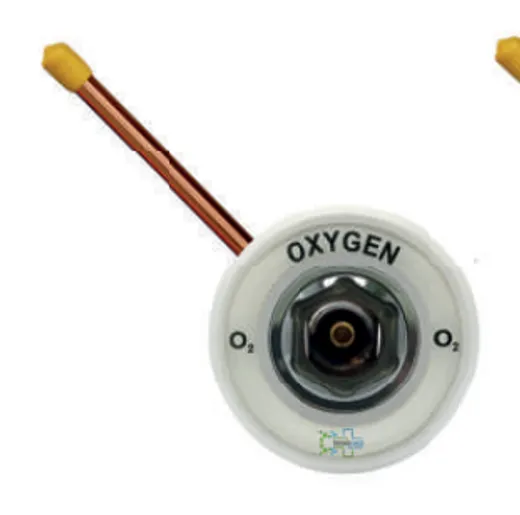
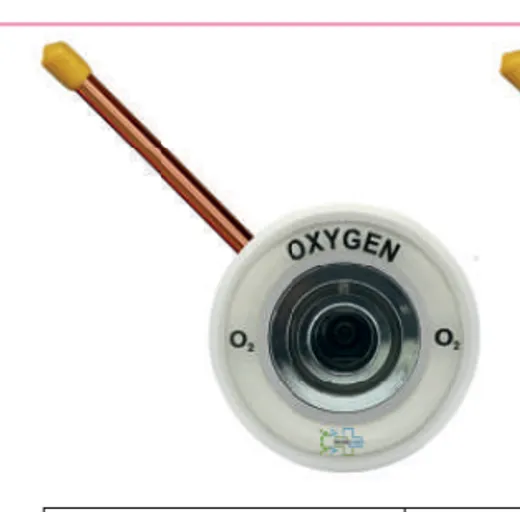
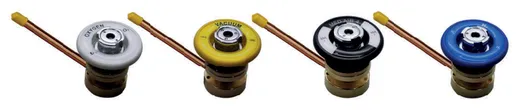
DIN 13260-2 is the German system, widely used across central and eastern Europe, Türkiye, parts of the Middle East and much of Asia. It defines a gas-specific probe and socket geometry for each service, and Tecnomed lists all seven services against it: oxygen, nitrous oxide, medical air 4 bar, surgical air 7 bar, medical vacuum, carbon dioxide and nitrogen.
Tecnomed DIN outlets are offered in four connection variants per gas, 45 degree pipe, 90 degree pipe, 45 degree union and rear outlet, and in two constructions. The MC model has body and upper head entirely in brass; the PC model pairs a brass lower block with an ABS plastic upper cover. Both use the same check valve, four stainless steel locking pins and silicone sealing arrangement.
BS 5682 probe and socket system
BS 5682 is the British system and follows UK healthcare practice, which means it dominates in the United Kingdom, Ireland, much of the Gulf, southern and eastern Africa, Pakistan and other regions where HTM 02-01 is specified. Where a tender references HTM 02-01, BS 5682 terminal units are usually expected as well.
Tecnomed supplies BS 5682 outlets in the same four connection variants and the same MC and PC constructions as its DIN range, plus two specialised families. The Eva series is a cost-efficient BS 5682 outlet with all gas-wetted parts in M58 forged brass and a housing in ABS and glass-fibre reinforced plastics, designed for one-finger probe release. The Mega series is an all-metal premium outlet with a five-year warranty, available in BS 5682 or DIN 13260-2 geometry.
AFNOR NF S 90-116 system
AFNOR NF S 90-116 is the French system, used in France and across the francophone world: the Maghreb, west and central Africa, parts of the Middle East and several Indian Ocean territories. Hospitals built under French technical assistance or with French clinical partnerships almost always use it, and the installed equipment base follows.
Tecnomed lists all seven gas services to NF S 90-116 in the same four connection variants, built on the same degreased calibrated brass lower body, nickel-free chrome-plated gas separator housing and silicone sealing as the rest of the TEC61 range. AFNOR emergency inlets also appear on Tecnomed second stage regulators and double stage regulator panels, alongside NIST, which reflects how common the standard is in regulator applications.
Interchangeability, adapters and cross-standard risks
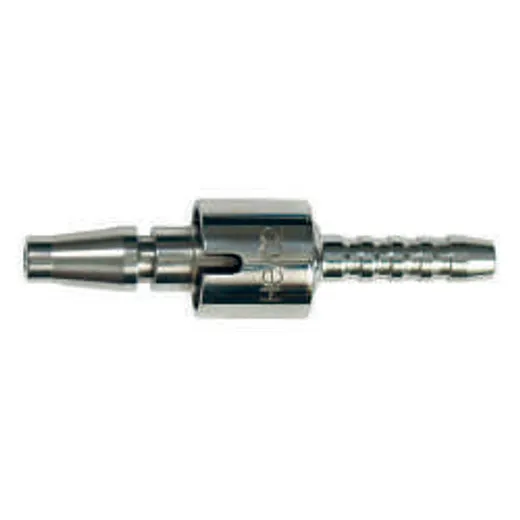
The three systems are deliberately incompatible, and that incompatibility is a safety feature. Adapters that convert one standard to another exist and are legitimately used in defined situations, for instance connecting imported equipment during a commissioning trial or supporting a transitional area during phased refurbishment. Every adapter, however, is an extra connection, an extra leak path and an extra opportunity for the wrong pairing.
Adapters should therefore be controlled items: recorded, gas specific, leak tested and used under an agreed procedure, not kept loose in a ward drawer. The genuinely dangerous practice is running two standards in one department so that staff routinely need an adapter to make equipment fit. If a hospital finds itself in that position, standardising the department is cheaper than the risk.
- No probe from one standard will enter a socket of another; this is intended
- Adapters are acceptable for defined, temporary, controlled situations only
- Every adapter must be gas specific, recorded and leak tested
- Never mix standards within a single clinical department
- Record the standard used in every zone in the as-built documentation
Regional preferences and tender requirements
The standard is usually decided before the tender is written, by the installed base and by the local service market. Check three things: what the hospital's existing outlets are, what the ventilators, flowmeters and suction equipment already in the building are fitted with, and what the local biomedical service companies stock as spares. All three usually point the same way.
Where they conflict, the equipment base tends to win, because replacing every probe and hose on installed equipment costs more than specifying matching outlets. Tecnomed manufactures all three standards on the same production line and within the same quality system, so a project can be supplied consistently in whichever standard is chosen without a change of supplier.
How to decide for a new hospital
For a greenfield hospital with no installed base, follow the region and the clinical partnership. If clinical practice, staff training and equipment procurement all follow British practice, choose BS 5682. If German or central European practice dominates, choose DIN 13260-2. In francophone regions choose AFNOR NF S 90-116 and stay with it.
Then write the decision into the project standard and enforce it across every outlet, probe, flowmeter, regulator and hose in the building, including future phases. Record it in the as-built documentation and in the medical gas operational policy, so the estates team fifteen years from now specifies the right spares. Consistency is worth far more over a hospital's life than any technical difference between the three systems.
Frequently asked questions
Which medical gas outlet standard is best?
None of them is technically superior. DIN 13260-2, BS 5682 and AFNOR NF S 90-116 all provide gas-specific, non-interchangeable connections that satisfy EN ISO 7396-1. The right choice is the one that matches your existing outlets, your installed clinical equipment and your local spares and service market.
Can I use a BS probe in a DIN outlet?
No. The geometries are deliberately incompatible so that equipment cannot be connected to the wrong gas or the wrong system. Adapters exist for controlled, temporary situations, but routine reliance on adapters within a clinical area should be treated as a defect to be corrected, not a working arrangement.
Can one hospital use more than one standard?
It happens, usually after phased extensions by different contractors, but it should be avoided and corrected where practical. If two standards exist, keep the boundary at department level, document which zone uses which standard, and control adapters formally rather than leaving them loose on wards.
Does the choice of standard affect the rest of the pipeline?
No. The pipework, valves, plant, alarms and testing regime under EN ISO 7396-1 are identical whichever terminal unit standard is chosen. The standard only determines the probe geometry at the outlet and therefore which probes, flowmeters, regulators and hoses the hospital must stock.