Scope of EN ISO 7396-1
The standard applies to pipeline systems for compressed medical gases, medical vacuum and anaesthetic gas scavenging in healthcare facilities. It addresses design, installation, function, performance, documentation, testing and commissioning, and it treats the whole installation as a single medical device system rather than as an assembly of separately compliant components.
That system view is its most important characteristic. A hospital can install certified plant, certified valves and certified terminal units and still end up with a non-compliant system if redundancy, sizing, labelling or testing is wrong. Compliance is demonstrated by the completed test and validation file for the installation, not by a stack of component certificates.
Key definitions: source, distribution, terminal units
The source of supply is the plant producing or storing the gas: manifolds, PSA oxygen generators, liquid oxygen installations, medical air compressor plants and vacuum plants. Distribution is the pipework, valves and pressure regulation that carry gas from the source to the clinical areas, including the area valve service units that isolate each zone.
Terminal units are the gas-specific outlets at the point of use. The standard also defines the monitoring and alarm system as an integral part of the installation, since pipeline status is otherwise invisible to the people relying on it. Each of these elements carries its own requirements, and each is verified separately during commissioning.
Supply system and redundancy requirements
The central safety principle is that no single failure may interrupt supply. The standard requires three levels for each gas: a primary supply carrying the normal load, a secondary supply that takes over automatically when the primary is exhausted or fails, and a reserve that covers failure of both. Each must be capable of meeting the design flow on its own.
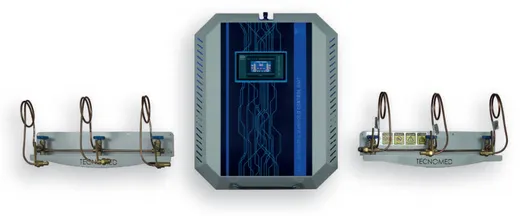
For a cylinder manifold this is the duty bank, the standby bank and an independent reserve, with automatic changeover between the first two. For a PSA oxygen plant or a liquid oxygen installation it typically means duplicated production or storage plus a cylinder manifold reserve. Emergency NIST or AFNOR inlets on area regulator panels give a further route for connecting a temporary supply, which Tecnomed provides on its double stage regulator panels and second stage regulators.
Materials, brazing and pipeline installation rules
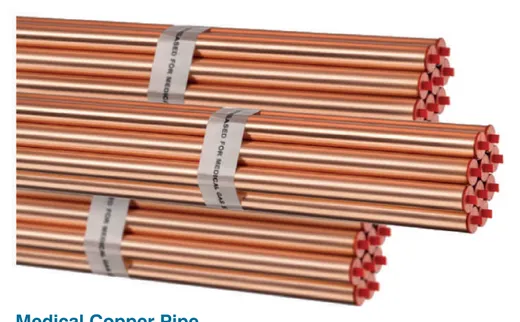
Pipework is medical grade copper to EN 13348, supplied degreased, capped at both ends and marked with the standard and diameter along its length. Tecnomed supplies seamless EN 13348 copper in five-metre lengths closed with caps and marked with the norm and diameter on every pipe, together with the fittings, clamps, sleeves and clamp rail needed to install it.
Joints are brazed with an inert gas purge flowing through the pipe, so that no copper oxide scale forms on the inside of the joint. Scale is a particulate contaminant that later reaches terminal units and clinical equipment, and it cannot be removed once formed. Pipework must also be supported at the specified clamp spacing, labelled with gas identity and flow direction, and kept capped until the moment of connection.
- Medical copper tube to EN 13348, degreased and capped
- Brazing under a continuous inert gas purge to prevent internal oxidation
- Clamp spacing and support to the specified intervals
- Pipework labelled with gas identity and flow direction along its route
- Sizing verified for design flow at the most remote terminal unit
Terminal unit and valve requirements
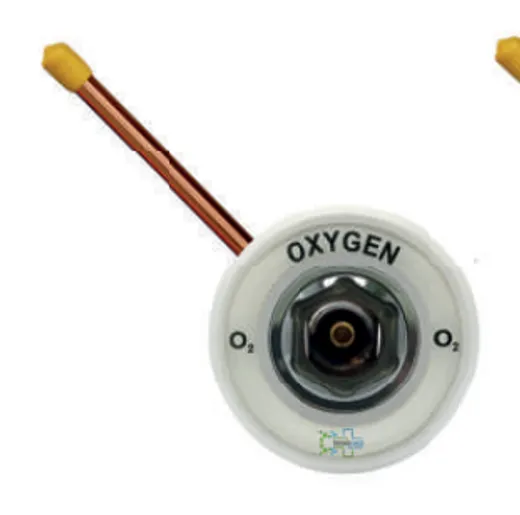
Terminal units must be gas specific, so that a probe for one gas cannot be inserted into an outlet for another, and must be permanently marked with the gas identity. They must seal automatically on withdrawal of the probe and be capable of the rated flow at the design pressure. Tecnomed manufactures its terminal units to DIN 13260-2, BS 5682 and AFNOR NF S 90-116 with a check valve, stainless steel locking pins and silicone sealing, each one leak tested before dispatch.
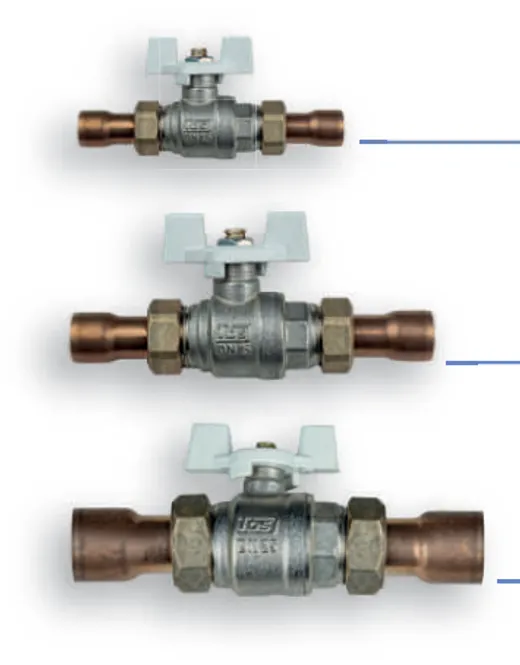
Valves must provide a clear hierarchy of isolation from source to area to local level, and must be suitable for oxygen service. Tecnomed medical gas ball valves are drop forged MS 58 brass with chrome plated brass balls, all parts degreased before assembly, an oxygen-compatible lubricant in the ball section, an operating pressure of 16 bar and a 100 percent electronic leakproofness test, in sizes from DN15 to DN65.
Testing, commissioning and certification
The testing sequence is defined and must be followed in order. Mechanical integrity and leakage are verified first. Cross connection testing then proves that every single outlet delivers only its own gas, outlet by outlet, with no sampling. The system is purged and checked for particulates, then the gas at the outlet is verified for identity and quality.
Finally, flow and pressure performance is tested at the design condition, and every alarm is verified at every location where it should appear. The completed records form the validation file, and clinical release follows a documented quality check at the terminal units. Any later modification, however small, requires the affected section to be retested before it is handed back.
- Leak and mechanical integrity testing
- Cross connection testing of every terminal unit individually
- Purging and particulate verification
- Gas identity and quality testing at the outlet
- Flow and pressure performance at the design condition
- Alarm verification at every display location
- Documented release before clinical use
Related standards you also need
EN ISO 7396-1 does not stand alone. EN 13348 governs the copper tube. DIN 13260-2, BS 5682 and AFNOR NF S 90-116 define the terminal unit and probe geometries. EN 739 covers low-pressure hose assemblies and their colour coding. EN 11197 covers bed head units and other medical supply units that carry the outlets.
Alongside these sit management and quality frameworks. HTM 02-01 provides the operational regime of authorised persons, permits, testing and maintenance. ISO 13485 governs the manufacturer's quality management system. Tecnomed manufactures to EN ISO 7396-1 within an ISO 13485 system and supplies products referenced to each of these related standards, which keeps the documentation chain consistent from the plant room to the outlet.
Frequently asked questions
Does EN ISO 7396-1 apply to vacuum and scavenging as well as gases?
Yes. The standard covers pipeline systems for compressed medical gases, medical vacuum and anaesthetic gas scavenging. Vacuum and AGSS are subject to the same principles of redundancy, gas-specific terminal units, monitoring and documented commissioning as the compressed gas services.
Why must brazing be done under an inert gas purge?
Heating copper in air forms oxide scale on the inside of the joint. That scale later breaks away as particulate contamination and reaches terminal units and clinical equipment, and it cannot be removed afterwards. A continuous inert purge through the pipe during brazing prevents the scale from forming at all.
Is every outlet tested for cross connection, or only a sample?
Every outlet, individually. Cross connection is the most serious failure mode in a medical gas system, so the standard requires each terminal unit to be proven to deliver only its own gas. Sampling is not acceptable, and the same applies to any outlet added or modified later.
Does compliance with EN ISO 7396-1 mean we also meet HTM 02-01?
Not automatically. EN ISO 7396-1 sets the technical requirements for the installed system. HTM 02-01 adds the operational management framework, including authorised person roles, permit to work, planned maintenance and record keeping. Projects specifying HTM 02-01 expect both to be satisfied.