Parts of a wall-mounted oxygen flowmeter
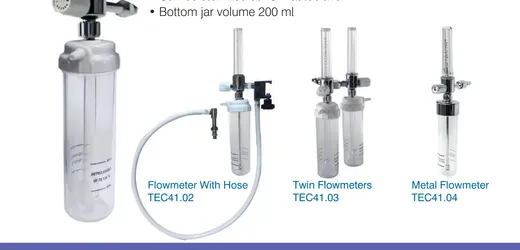
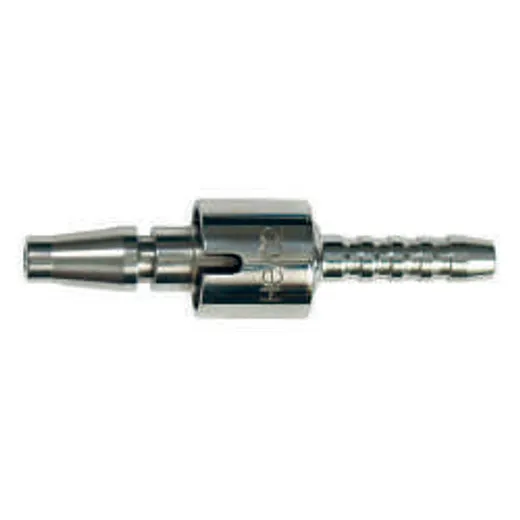
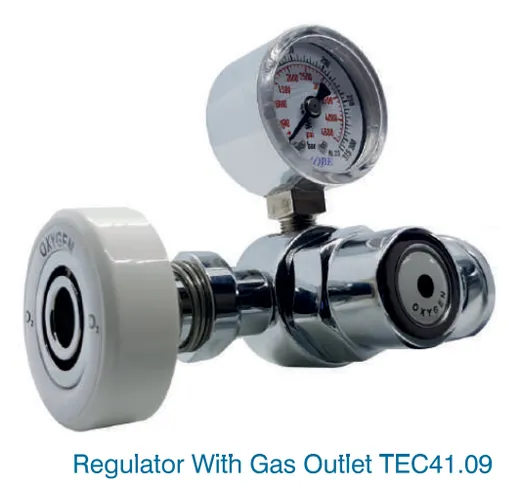
A wall flowmeter has four functional parts: a gas-specific probe that connects it to the terminal unit, a body containing the needle valve operated by the control knob, a graduated flow tube holding the float, and an outlet nipple for the delivery tubing. Tecnomed oxygen flowmeters have a brass main body with a clearly graduated scale, and offer humidification up to 15 litres per minute.
The humidifier is a separate component that screws below the body. The Tecnomed bottom jar is polycarbonate with a 200 ml volume, detachable for refilling and cleaning and sterilisable in an autoclave at 134 degrees Celsius. The range covers single flowmeters, twin flowmeters, a hose-fed version and an all-metal version, with probes to DIN 13260-2, BS 5682, AFNOR NF S 90-116 or AFROX SANS 1409.
Connecting the probe to the terminal unit safely
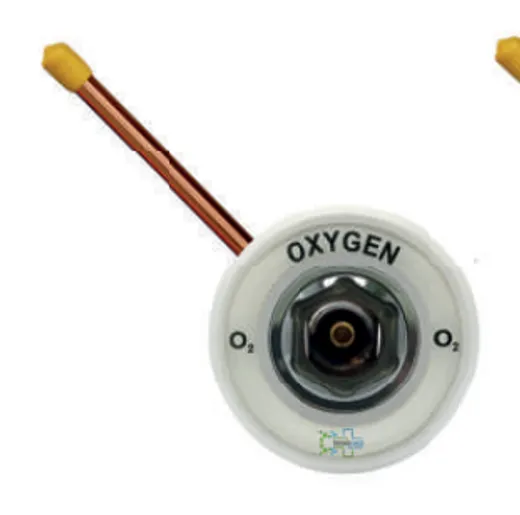
Check the outlet first. Confirm the label reads oxygen and that the colour code matches, then check the probe is the matching gas and standard. If the probe does not enter easily, stop; do not force it and never use an adapter to make a non-matching probe fit. Difficulty entering is the safety system working as designed.
Push the probe in squarely until the locking pins engage with an audible click, then give a light pull to confirm it is retained. Around 100 N is needed to connect a Tecnomed terminal unit and 110 N to release it, so a properly seated probe will not come out under the weight of a hose. Listen for a leak at the joint, and support the flowmeter so that tubing is not pulling it sideways in the socket.
Reading the float scale correctly
Read the scale at eye level and take the value at the centre of a ball float. Reading from above or below introduces a parallax error that is easily two litres per minute at higher settings, which matters when a patient is being titrated. The flowmeter must also be vertical: mounted at an angle, the float will not track the scale accurately.
Open the control knob slowly. A sudden opening drives the float hard against the top stop, where it can stick and read nothing meaningful. If the float sits at the top and does not respond to the knob, close the valve fully, let it settle and reopen gently. Watch the float actually move as you adjust; a float that does not move is not measuring.
Setting flow for common delivery devices
Flow is set by the clinical prescription and the delivery device, not by the flowmeter. Each device has a flow range in which it works as designed: nasal cannulae operate at low flows, simple masks need enough flow to clear exhaled gas from the mask, and reservoir masks need enough flow to keep the bag inflated throughout inspiration. Venturi devices require the specific flow printed on the fitting to achieve their stated concentration.
Two practical rules apply everywhere. Never run a device below the minimum flow its manufacturer states, because rebreathing can result. And always confirm the flowmeter is actually delivering: check that the float has moved, that the patient tubing is connected at both ends and that the humidifier, if fitted, is bubbling. Tecnomed flowmeters provide 0 to 15 litres per minute with humidification.
When and how to use the humidifier bottle
Humidification is a clinical decision governed by local policy. Short-term oxygen at low flow through nasal cannulae is commonly delivered dry, while higher flows, longer therapy and delivery past an artificial airway usually need humidification to protect the mucosa. Follow the hospital protocol rather than habit, and do not fit a bottle simply because the flowmeter has a thread for one.
Fill the bottle with sterile water to the marked level, never above it, and never top up a partially used bottle: discard and refit a clean one. The Tecnomed 200 ml polycarbonate jar detaches easily for this. Keep the bottle upright and below the patient so condensate cannot run down the tubing, and change it at the interval set by the infection control policy.
Cleaning, disinfection and replacement intervals
The humidifier jar is the part that needs regular attention. Tecnomed polycarbonate jars are autoclavable at 134 degrees Celsius, so they can be reprocessed through the hospital's normal sterile services route. Wipe the flowmeter body and probe with the approved disinfectant between patients, keeping fluid out of the flow tube and away from the outlet nipple.
Never use oil, grease or any oil-based lubricant on an oxygen flowmeter, probe or terminal unit. Hydrocarbons in an oxygen-enriched atmosphere are a serious fire risk, and this applies to hand creams and lubricant sprays as well as to workshop oils. Flowmeters should be included in the biomedical inventory with a defined calibration or replacement interval rather than being used until they visibly fail.
Troubleshooting leaks and stuck floats
Most flowmeter problems are simple and can be resolved at the bedside in under a minute. The ones that cannot should go to biomedical engineering rather than being adjusted on the ward, because a flowmeter that reads incorrectly is considerably more dangerous than one that has obviously failed and been taken out of service.
Label and remove any flowmeter you suspect, rather than leaving it on the wall for the next shift to find. A quarantine point in the ward equipment store and a short fault note attached to the device are enough, and they prevent the common sequence in which a faulty unit is returned to use because nobody recorded what was wrong with it.
- Hissing at the outlet: probe not fully seated, or worn probe sealing surface. Remove, inspect, reinsert
- Float stuck at the top of the tube: valve opened too quickly. Close fully, allow to settle, reopen slowly
- Float does not move at all: blocked flow tube or a failed needle valve. Take out of service
- Bubbling but no flow to the patient: tubing disconnected or kinked between bottle and device
- Water in the flow tube: humidifier overfilled or flowmeter used inverted. Take out of service
- Reading does not match a second flowmeter: calibration drift. Refer to biomedical engineering
Frequently asked questions
Where exactly do I read the float?
At eye level, taking the value at the centre of a ball float against the scale. Reading from above or below causes parallax error of several litres per minute at higher flows. The flowmeter must also be mounted vertically, because a tilted tube will not track the scale correctly.
Does every oxygen patient need a humidifier bottle?
No. Humidification follows hospital protocol. Short-term low-flow oxygen through nasal cannulae is usually delivered dry, while higher flows, prolonged therapy and delivery past an artificial airway generally require humidification. Fit a bottle because the protocol calls for it, not because the flowmeter accepts one.
Can the humidifier bottle be sterilised?
Yes. Tecnomed polycarbonate humidifier jars are detachable and suitable for autoclaving at 134 degrees Celsius, so they can be reprocessed through sterile services. Fill only to the marked line with sterile water, and replace rather than top up a partially used bottle.
Why will my flowmeter probe not fit the outlet?
Almost always because the probe and the outlet are different gases or different standards. Probe geometries under DIN 13260-2, BS 5682 and AFNOR NF S 90-116 are intentionally non-interchangeable. Check the gas label and the standard, and never force a probe or use an adapter to make it fit.