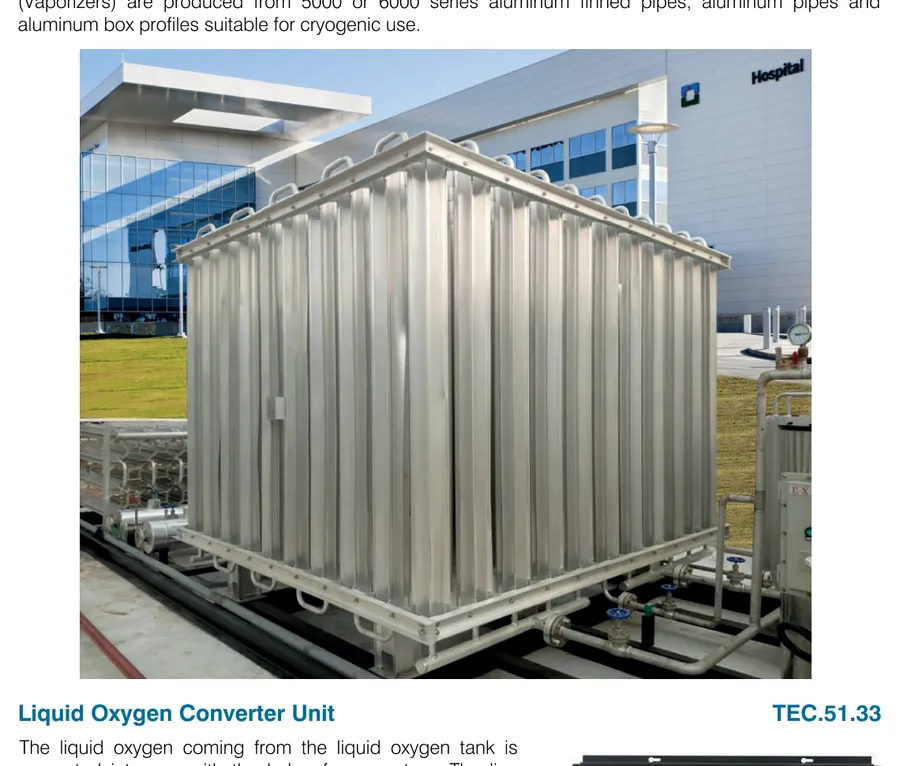
Overview
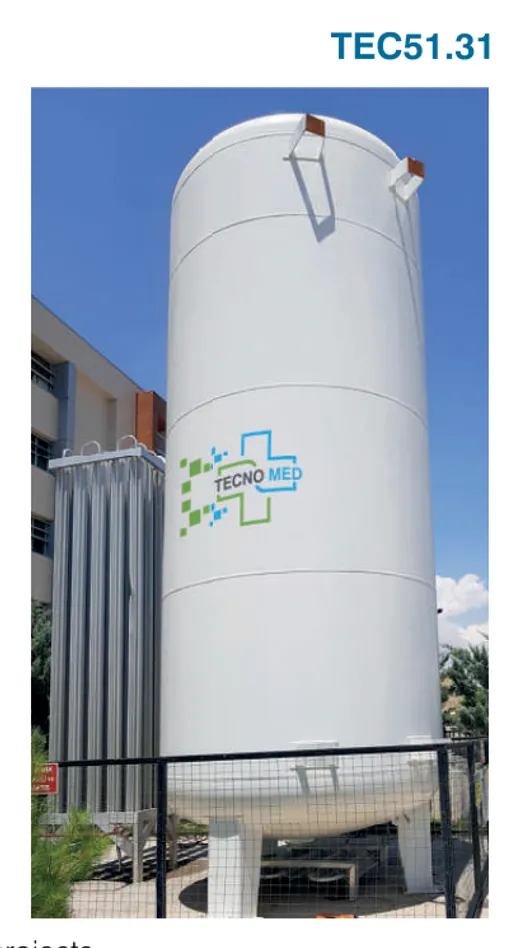
Evaporators, also called vaporizers, are coupled with liquid oxygen tanks and are the equipment that enable liquefied gases to evaporate and become usable gases. The working principle is entirely passive: the cryogenic liquid passes through the finned pipes and takes up heat it receives from the atmosphere, changing phase into gas along the way. There is no burner, no electrical heater and no moving part, which is what makes the unit reliable and maintenance-light in an outdoor plant compound.
Construction is all aluminium for cryogenic duty. Evaporators are produced from 5000 or 6000 series aluminium finned pipes, aluminium pipes and aluminium box profiles suitable for cryogenic use. The fins provide the heat transfer surface that the process depends on, and the frame is sized so the assembly stands as a self-supporting block next to the tank. In continuous high-demand installations, evaporators are often specified in duty and standby pairs so one bank can be defrosted while the other carries the load.
Evaporator capacity is matched to the LOX tank it serves. Across the Tecnomed liquid oxygen range, capacities run from 100-200 m³/h for 3 m³ and 5 m³ tanks, through 400 m³/h and 600 m³/h for 10 m³ and 15 m³ tanks, up to 600-700, 700-800 and 800 m³/h for 20 m³, 25 m³ and 30 m³ tanks. The line pressure at the end of the evaporators is 15 bar, which the liquid oxygen converter unit then reduces to the 4-5 bar the hospital pipeline works at.
Key features
- Coupled with liquid oxygen (LOX) tanks
- Ambient air operation using heat received from the atmosphere
- No burner, heater or moving parts
- 5000 or 6000 series aluminium finned pipes
- Aluminium pipes and aluminium box profiles suitable for cryogenic use
- Capacities matched to the tank, from 100 m³/h to 800 m³/h
- 15 bar line pressure at the evaporator outlet
- Self-supporting outdoor block construction
Technical specifications
Evaporator Capacity by LOX Tank Volume
| LOX Tank Product Code | Tank Volume | Evaporator Capacity |
|---|---|---|
| TEC.51.31.01 | 3 m³ | 100 - 200 m³/h |
| TEC.51.31.02 | 5 m³ | 100 - 200 m³/h |
| TEC.51.31.03 | 10 m³ | 400 m³/h |
| TEC.51.31.04 | 15 m³ | 600 m³/h |
| TEC.51.31.05 | 20 m³ | 600 - 700 m³/h |
| TEC.51.31.06 | 25 m³ | 700 - 800 m³/h |
| TEC.51.31.07 | 30 m³ | 800 m³/h |
Models and product codes
| Product code | Models and product codes |
|---|---|
TEC.51.32 | Ambient Air Evaporator (Vaporizer) – Aluminium finned cryogenic evaporator, capacity matched to the LOX tank |
Options and accessories
- Capacity selected to match the liquid oxygen tank volume
- Duty and standby evaporator banks for continuous high demand
- Project-specific frame dimensions and pipe routing
Frequently asked questions
How does an ambient air evaporator work without power?
It is a passive heat exchanger. Cryogenic liquid flowing through the finned aluminium pipes absorbs heat from the surrounding air, which is enough to boil it into gas. No electricity, fuel or moving part is involved, so the unit consumes nothing and has very little to fail.
Why is the body made of aluminium?
Aluminium keeps its toughness at cryogenic temperatures and conducts heat well, which is exactly what a vaporizer needs. Tecnomed evaporators use 5000 or 6000 series aluminium finned pipes together with aluminium pipes and box profiles suitable for cryogenic use.
What capacity of evaporator do we need?
Capacity is matched to the LOX tank and the oxygen demand. In the Tecnomed range this runs from 100-200 m³/h for 3 and 5 m³ tanks up to 800 m³/h for a 30 m³ tank. All system capacities and components may differ according to the project.