Definition: the terminal unit at the end of the pipeline
Everything upstream of the terminal unit is fixed installation: plant, distribution pipework, valves and monitoring. Everything downstream is clinical equipment: flowmeters, regulators, hoses, ventilators and suction sets. The terminal unit is the interface between the two, and it is the only part of the pipeline that clinical staff touch dozens of times a day.
That makes it the most heavily cycled component in the whole system and the one most exposed to misuse. It has to seal reliably after tens of thousands of insertions, resist being pulled sideways by a hose, survive repeated disinfection and still accept only its own gas. Tecnomed terminal units are supplied with every unit leak tested before dispatch, manufactured to EN ISO 7396-1 within an ISO 13485 quality system.
How the gas-specific index prevents cross connection
Cross connection, delivering the wrong gas at an outlet, is the most serious failure a medical gas system can produce. The defence is mechanical rather than procedural: each gas has a unique probe geometry, and a probe for one gas physically cannot enter the socket of another. This is designed into the standard, whether DIN 13260-2, BS 5682 or AFNOR NF S 90-116.
The indexing works only if the whole chain is consistent. A DIN oxygen socket, a DIN oxygen probe and DIN oxygen equipment form a safe chain. Introduce an adapter, and the mechanical protection is bypassed. This is the reason cross connection testing at commissioning tests every outlet individually rather than sampling, and why adapters between standards are treated with great caution.
Parts: base block, valve, socket assembly and front cover
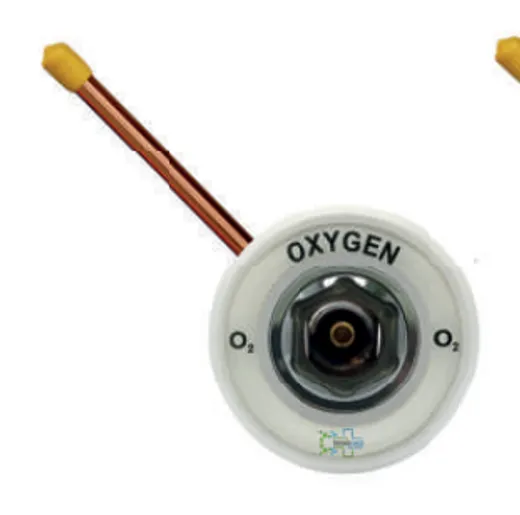
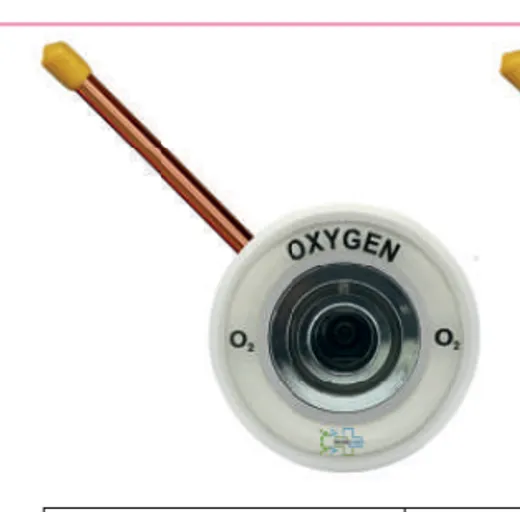
The base block is the part brazed or connected to the pipeline, machined from calibrated brass and degreased for medical service. Tecnomed supplies it with a standard 8 mm copper tail 120 mm long, with 10 mm and 12 mm available as options, and in 45 degree pipe, 90 degree pipe, 45 degree union and rear outlet connection versions so it suits any wall, bed head or pendant arrangement.
Above the block sits the socket assembly with its check valve, its gas separator housing in nickel-free chrome-plated brass and its silicone sealing gaskets. Four stainless steel pins lock the probe in place, with around 100 N required to connect and 110 N to disconnect. The check valve interrupts the gas flow when the upper body is removed, so a socket can be serviced without isolating the zone.
- Base block: calibrated degreased brass, 8 mm copper tail as standard
- Connection versions: 45 degree pipe, 90 degree pipe, 45 degree union, rear outlet
- Check valve isolating the gas when the upper body is removed
- Four stainless steel locking pins, 100 N connection and 110 N disconnection force
- Nickel-free chrome-plated brass gas separator housing with silicone gaskets
- Front cover with gas name, symbol and colour code
Gas colour codes and identification labels
Colour coding is a rapid identification aid and a cross check, never the primary safety mechanism. Colour conventions differ between regions, which is precisely why the mechanical index rather than the colour is what prevents cross connection. Whatever convention the hospital uses must be applied consistently across outlets, hoses, probes and pipeline labelling.
Text and symbol marking must appear on the outlet face itself, not only on a removable cover, so that identification survives maintenance. Tecnomed terminal units are supplied colour coded and gas marked, and the same convention is carried through to EN 739 colour-coded medical gas hoses and to gas-specific probes, so the chain from wall to patient reads consistently.
Flush, recessed and surface mounting options
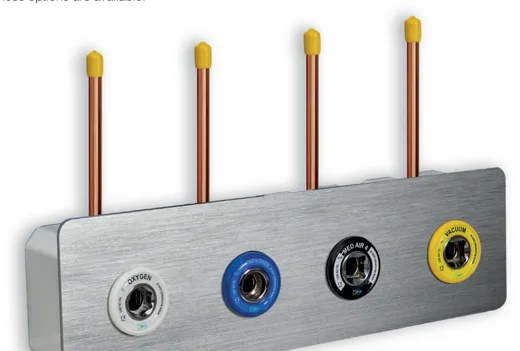
Terminal units are installed in three main ways. Inside a bed head unit or pendant they mount into the extruded profile, which is the most common arrangement in patient rooms and intensive care. In a wall gas module they are grouped in an aluminium body carrying one to six outlets, available on-plaster for surface mounting or under-plaster for flush mounting, with a standard or stainless steel cover.
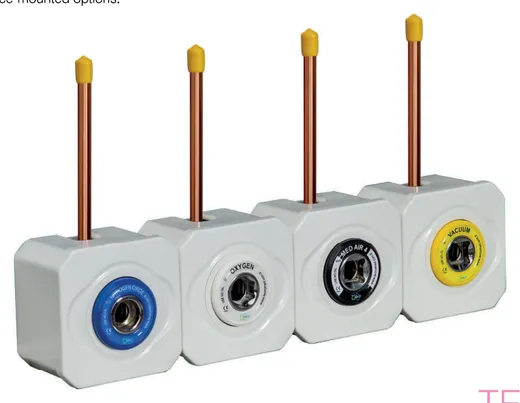
The third option is an individual wall-mounted terminal box, used where a single service is needed away from a bed head, for example in a plaster room, a store or a corridor equipment point. Tecnomed terminal wall-mount outlets put one socket in a compact moulded case with rounded corners, available in BS 5682, DIN 13260-2 and AFNOR patterns for all seven gas services.
Flow and pressure drop performance
Terminal units are tested for flow at a stated inlet pressure, and the pressure drop across the outlet is part of the system calculation. It is a small figure individually, but with a long branch, several fittings and a hose in series it becomes significant at high flow, which is why the design calculation is done to the most remote outlet at the design flow rather than to an average point.
Vacuum deserves particular attention because a terminal unit that performs well on oxygen can restrict vacuum flow noticeably. Where high suction flow is required, check the vacuum terminal unit performance specifically rather than assuming the whole range behaves identically. Performance is verified again at commissioning under EN ISO 7396-1 flow and pressure testing.
Where outlets are required in each department
Outlet schedules come from the national health building guidance and the clinical brief, but the pattern is consistent. Ward beds have oxygen and vacuum. High-dependency beds add medical air at 4 bar. Intensive care beds carry substantially more of each. Operating theatres add surgical air at 7 bar, nitrous oxide where used, and anaesthetic gas scavenging.
Three points are regularly forgotten at design stage and expensive to add later: the resuscitation trolley position in every ward corridor, the plaster and treatment rooms, and the equipment servicing bay where biomedical engineering tests ventilators and suction units. Adding an outlet later means brazing into a live system under a permit and retesting that branch.
- General ward bed: oxygen and vacuum
- High-dependency bed: oxygen, vacuum and medical air 4 bar
- Intensive care bed: multiple oxygen, vacuum and medical air outlets
- Operating theatre: oxygen, vacuum, medical air, surgical air 7 bar, nitrous oxide, AGSS
- Recovery, delivery and emergency: oxygen, vacuum and medical air per bay
- Corridor resuscitation points, plaster rooms and biomedical workshops
Frequently asked questions
What is the difference between a medical gas outlet and a terminal unit?
They are the same component. Terminal unit is the term used in EN ISO 7396-1 and in tender documents, while medical gas outlet, gas point and wall outlet are everyday usage. All describe the self-sealing, gas-specific socket where equipment connects to the hospital pipeline.
Can a terminal unit be serviced without shutting down the zone?
Yes. Tecnomed terminal units include a check valve that interrupts the gas flow when the upper body is removed, so the socket assembly can be replaced or serviced without isolating the area valve. The work still belongs to the estates team under the hospital's permit to work system.
What holds the probe in the outlet?
Four stainless steel locking pins engage the probe and hold it against line pressure. Tecnomed terminal units are designed for approximately 100 N connection force and 110 N to disconnect, which is firm enough to resist accidental hose pulls while remaining operable with one hand.
Are colour codes enough to prevent connecting the wrong gas?
No, and they are not intended to be. Colour coding is an identification aid; the actual protection is the gas-specific probe geometry defined in DIN 13260-2, BS 5682 or AFNOR NF S 90-116, which makes it mechanically impossible to insert the wrong probe into an outlet.