What HTM 02-01 covers and who it applies to
HTM 02-01 covers medical gas pipeline systems in their entirety: the source of supply, the distribution pipework, valves and terminal units, the alarm and monitoring system, and the operational management of all of it. It is published as guidance for healthcare estates in the United Kingdom, but it is written into tender documents worldwide because it provides a complete, practical framework.
It applies to anyone who designs, installs, validates, operates or maintains such a system, and it is explicitly a whole-life document. Many projects treat it as an installation specification and then stop reading at handover, which is precisely where the operational half of the guidance begins and where most long-term compliance problems originate.
Design responsibilities and the authorised person roles
The role structure is one of the most valuable parts of the document. HTM 02-01 defines who is accountable for a medical gas system and what competence each role requires, from the executive-level accountable officer down through the authorised person for medical gas pipeline systems, the competent person who carries out the work, the quality controller and the designated medical and nursing officers.
The practical consequence is that no work is carried out on a live medical gas system without the authorised person's knowledge and a permit to work. That single control prevents most of the serious incidents that occur on hospital pipelines, which typically arise when a well-meaning contractor isolates or modifies something without the estates team knowing.
- Accountable officer with executive responsibility for the system
- Authorised person for medical gas pipeline systems, controlling all work through permits
- Competent person carrying out installation and maintenance to the required competence
- Quality controller responsible for verifying gas quality before clinical use
- Designated medical and nursing officers representing clinical need and sign-off
Source of supply requirements including manifolds
HTM 02-01 requires supply systems capable of meeting the design flow continuously, with primary, secondary and reserve supplies, and with sufficient stored capacity that a delivery or plant failure does not become a clinical emergency. That applies whether the source is a cylinder manifold, a PSA oxygen plant, a liquid oxygen installation or a compressed air and vacuum plant.
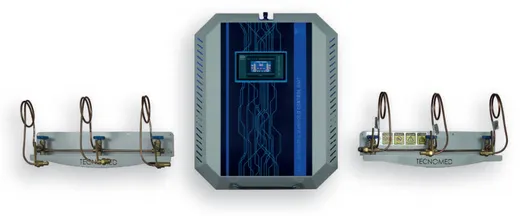
For manifolds specifically, that means automatic changeover between duty and standby banks, an independent reserve, appropriate ventilation, fire protection and access control for the manifold room, and alarm signals for changeover and low contents reaching a continuously staffed location. Tecnomed automatic manifold supply units and their alarm control units are built to satisfy both HTM 02-01 and EN ISO 7396-1.
Pipeline distribution, valves and terminal units
Distribution pipework is medical grade copper to EN 13348, degreased, capped until installation, brazed under a nitrogen purge to prevent internal oxide formation, supported at defined intervals and labelled along its route with gas identity and flow direction. Pipe sizing must satisfy the design flow at the most remote terminal unit without excessive pressure drop.
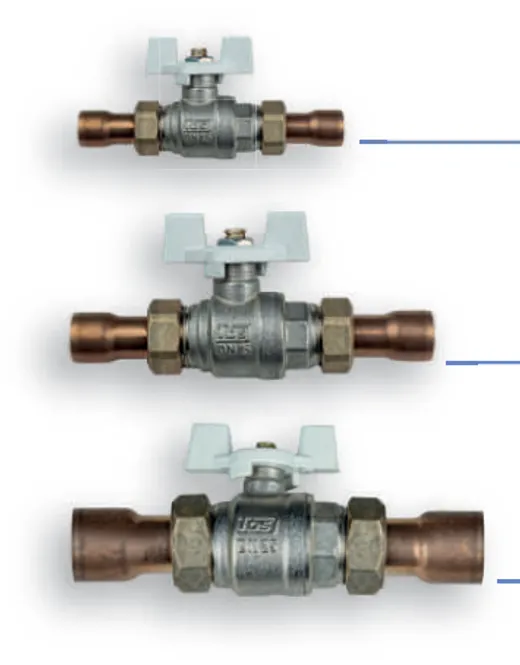
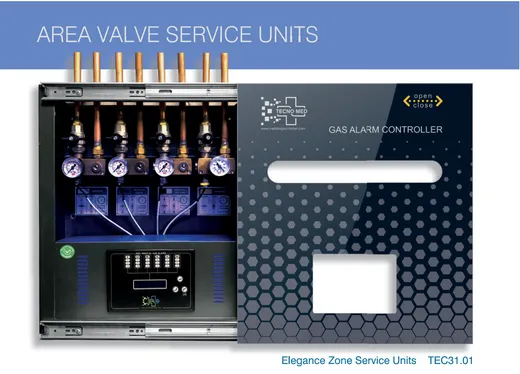
The valve hierarchy runs from source isolation through main and riser valves to area valve service units and local valves. Terminal units must be gas specific so that cross connection is physically impossible, and Tecnomed supplies these to BS 5682, DIN 13260-2 or AFNOR NF S 90-116 along with medical gas ball valves referenced to HTM 02-01 and the NHS model engineering specification for medical gases.
Alarm and monitoring requirements
HTM 02-01 requires source, operating and area alarms, with audible and visual indication, repeated where necessary so that the right people see the right alarm. Area alarms go to clinical staff in the zone; plant alarms go to estates and the authorised person. Muting the sound must never remove the visual indication while the condition persists.
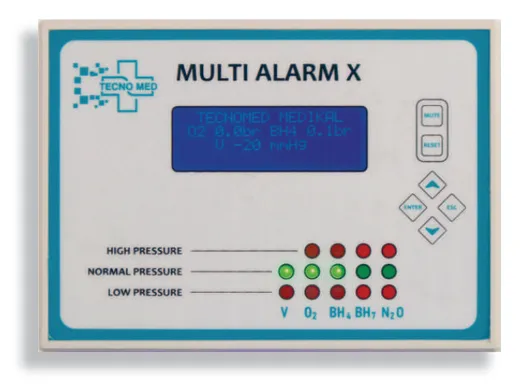
Modern installations add digital monitoring on top of that requirement. The Tecnomed Multi Alarm X displays pressure values for each gas on an LCD, provides high and low pressure alarms as high priority indications, and reports values, limits and alarm states to the automation system over RS485 Modbus, which supports trend analysis and planned maintenance.
Testing, commissioning and validation
Validation is a staged process, and the order matters. Pipework is tested for leakage and mechanical integrity, then for cross connection to prove every outlet delivers only its own gas, then purged and checked for particulates and for gas quality and identity, and finally tested for flow and pressure performance at the terminal units.
The final release for clinical use is a quality control check that the gas at the outlet is the correct gas at the correct quality, signed by the quality controller. Any modification, however small, restarts the relevant part of this sequence for the affected section. A single added outlet still requires cross connection and quality testing on that branch before it can be used.
- Leak and pressure integrity testing of the installed pipework
- Cross connection testing of every terminal unit, gas by gas
- Purging and particulate testing
- Gas identity and quality testing at the outlet
- Flow and pressure performance testing at the design condition
- Alarm verification at every display location
- Quality control release signed before clinical use
How HTM 02-01 relates to EN ISO 7396-1
The two documents are complementary rather than alternatives. EN ISO 7396-1 is the international standard defining the technical requirements a medical gas pipeline system must meet: supply redundancy, materials, terminal units, valves, monitoring and the testing needed to demonstrate compliance. It is the benchmark the product and the installation are measured against.
HTM 02-01 wraps a management system around that technical core, adding the roles, permits, training, documentation and maintenance regime that keep the system compliant for the next thirty years. A hospital specifying both is asking for a system that meets the standard on the day of handover and is still safe and auditable a decade later. Tecnomed products are manufactured to EN ISO 7396-1 within an ISO 13485 quality system and are widely specified on HTM 02-01 projects.
Frequently asked questions
Is HTM 02-01 mandatory outside the United Kingdom?
It is UK health guidance rather than international law, but it is frequently written into tender documents across the Middle East, Africa and Asia because it provides a complete design and management framework. Where it is specified contractually, compliance becomes a contractual obligation for the supplier and installer.
What is the difference between HTM 02-01 and EN ISO 7396-1?
EN ISO 7396-1 sets the technical requirements the installed system must satisfy, including supply redundancy, materials, terminal units and testing. HTM 02-01 adds the operational management framework around it: authorised person roles, permit to work, documented validation, planned maintenance and training over the system's whole life.
Who signs off a medical gas system before clinical use?
Under HTM 02-01 the quality controller performs the final quality check at the terminal units and signs the release, with the authorised person having controlled the work throughout and the designated medical and nursing officers confirming clinical acceptance. No system should be used clinically before that release is recorded.
Does adding one extra outlet require full retesting?
Not of the whole hospital, but the affected section must be retested. Leak testing, cross connection testing, purging, particulate and gas quality checks and a quality control release all apply to the modified branch before it is handed back for clinical use, under the permit to work system.