Overview
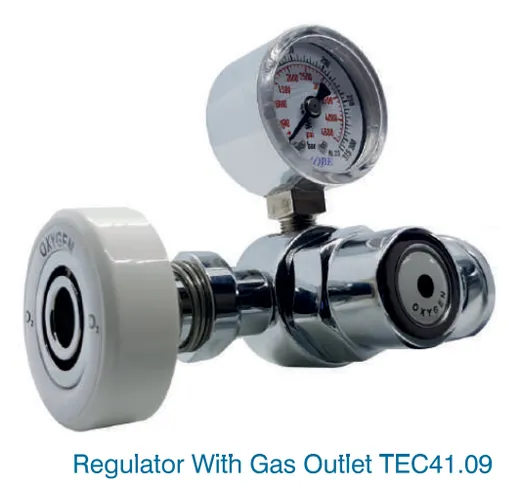
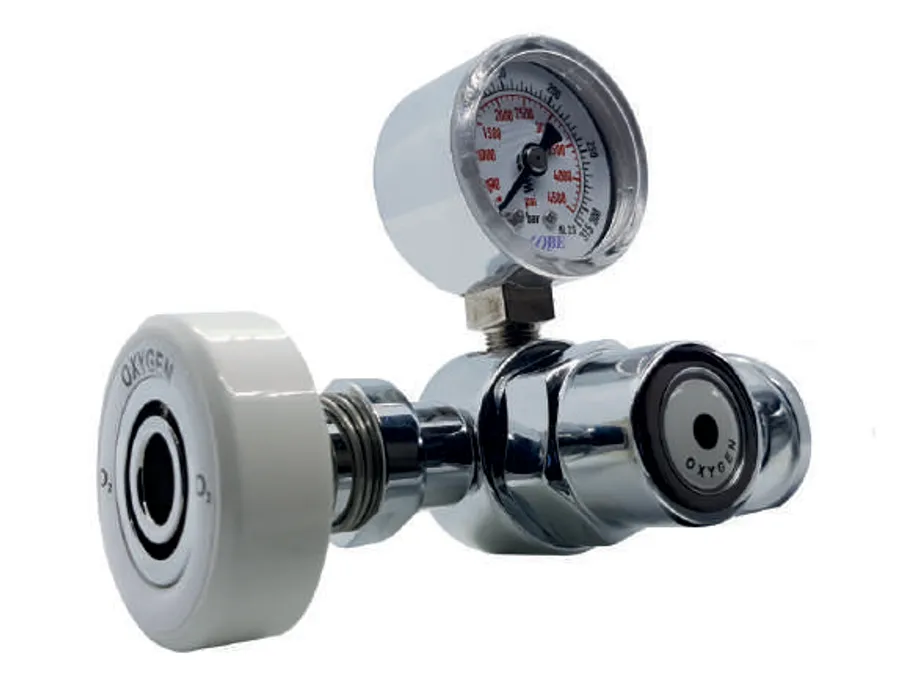
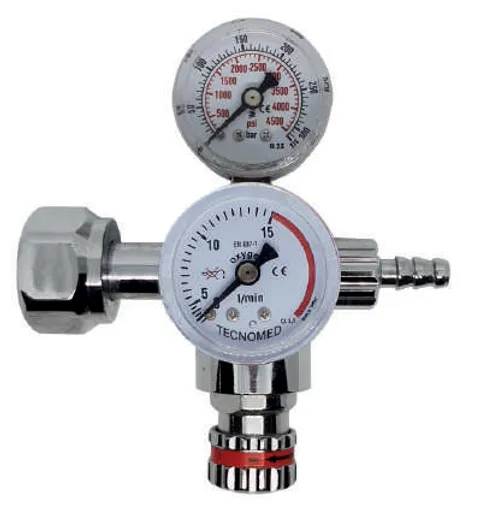
An oxygen cylinder regulator screws directly onto the cylinder valve and drops stored pressure to a level that patient equipment can accept. Tecnomed regulators are used on ward backup cylinders, in ambulances and in areas that sit outside the pipeline network. The inlet manometer shows remaining cylinder contents across a 0-315 bar scale, while the outlet side is set by the regulating stem; an optional second gauge shows delivery pressure so the user can confirm the setting without a separate test gauge.
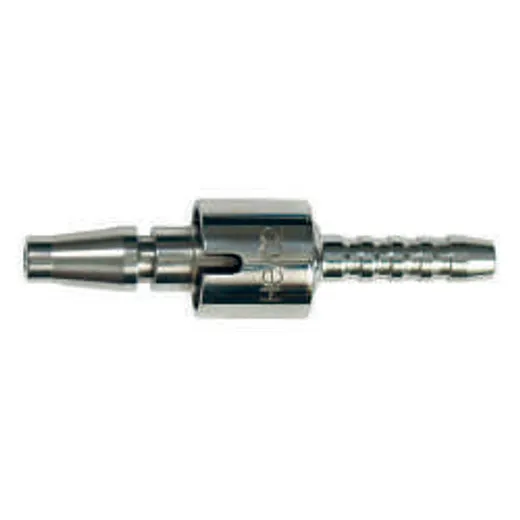
The body is brass, plated in chrome for corrosion resistance and easy cleaning, and is rated for a maximum gas supply pressure of 250 bar. Regulator output pressure is adjustable from 16 bar down to 0.2 bar, covering both equipment feed and direct therapy duties. The cylinder connection is made with a Bull Nose BS-341 nut, a DIN thread or a Pin Index yoke, while the delivery side carries an outlet probe to BS 5682, DIN 13260-2 or AFNOR NF S 90-116 so hospital hoses and flowmeters connect without adapters.
Five gauge configurations are catalogued: double gauge with emergency outlet Model-1 and Model-2, double gauge, single gauge with emergency outlet, and single gauge. The emergency outlet lets a second device – a resuscitator, transport ventilator or humidifier – be fed from the same cylinder while the main line stays in service. Nine product codes cover the full matrix of inlet connection against outlet standard, so a tender specifying, for example, a DIN 13260-2 outlet on a Pin Index cylinder is met by a single catalogue code rather than an assembly of parts.
Key features
- Chrome-plated brass body
- Maximum gas supply pressure 250 bar
- Regulator manometer range 0-315 bar
- Regulator output pressure adjustable 16 bar > 0.2 bar
- Single gauge and double gauge configurations
- Optional emergency gas outlet for a second device
- Optional inlet and outlet manometers
- Cylinder inlet in Bull Nose BS-341, DIN or Pin Index
- Outlet probe to BS 5682, DIN 13260-2 or AFNOR NF S 90-116
- Suitable for hospital, medical area and ambulance use
Technical specifications
Oxygen Regulator Technical Data
| Property | Value |
|---|---|
| Body material | Brass plated chrome |
| Maximum gas supply pressure | 250 bar |
| Regulator manometer range | 0-315 bar |
| Regulator output pressure | 16 bar > 0.2 bar |
Oxygen Regulator Product Codes – Outlet Standard by Cylinder Connection
| Outlet Standard | Bull Nose (BS-341) | DIN | Pin Index |
|---|---|---|---|
| BS 5682 | TEC41.05.01 | TEC41.05.04 | TEC41.05.07 |
| DIN 13260-2 | TEC41.05.02 | TEC41.05.05 | TEC41.05.08 |
| AFNOR NF S 90-116 | TEC41.05.03 | TEC41.05.06 | TEC41.05.09 |
Gauge Configurations
| Configuration | Description |
|---|---|
| Double gauge with emergency outlet – Model-1 | Inlet and outlet manometers plus emergency gas outlet |
| Double gauge with emergency outlet – Model-2 | Alternative body layout with inlet and outlet manometers and emergency outlet |
| Double gauge | Inlet and outlet manometers, no emergency outlet |
| Single gauge with emergency outlet | Inlet manometer plus emergency gas outlet |
| Single gauge | Inlet manometer only |
Regulator Connect Standards
| Cylinder Connection |
|---|
| Bull Nose (BS 341) |
| DIN |
| Pin Index |
Models and product codes
| Product code | Models and product codes |
|---|---|
TEC41.05.01 | Oxygen Regulator – BS 5682 outlet, Bull Nose (BS-341) inlet – British outlet standard on Bull Nose cylinder valve |
TEC41.05.02 | Oxygen Regulator – DIN 13260-2 outlet, Bull Nose (BS-341) inlet – German outlet standard on Bull Nose cylinder valve |
TEC41.05.03 | Oxygen Regulator – AFNOR NF S 90-116 outlet, Bull Nose (BS-341) inlet – French outlet standard on Bull Nose cylinder valve |
TEC41.05.04 | Oxygen Regulator – BS 5682 outlet, DIN inlet – British outlet standard on DIN cylinder valve |
TEC41.05.05 | Oxygen Regulator – DIN 13260-2 outlet, DIN inlet – German outlet standard on DIN cylinder valve |
TEC41.05.06 | Oxygen Regulator – AFNOR NF S 90-116 outlet, DIN inlet – French outlet standard on DIN cylinder valve |
TEC41.05.07 | Oxygen Regulator – BS 5682 outlet, Pin Index inlet – British outlet standard on Pin Index yoke |
TEC41.05.08 | Oxygen Regulator – DIN 13260-2 outlet, Pin Index inlet – German outlet standard on Pin Index yoke |
TEC41.05.09 | Oxygen Regulator – AFNOR NF S 90-116 outlet, Pin Index inlet – French outlet standard on Pin Index yoke |
Options and accessories
- Emergency gas outlet
- Inlet manometer
- Outlet manometer
- Single or double gauge body
Frequently asked questions
What is the difference between Bull Nose, DIN and Pin Index?
They are three ways of attaching the regulator to the cylinder valve. Bull Nose to BS 341 uses a large nut and bullet-shaped nipple and is common in British-influenced markets. DIN uses a threaded connection widely specified in Europe. Pin Index is a yoke that clamps over the valve and is keyed by pins so only the correct gas fits. All three are available across the Tecnomed range; the choice is dictated by the cylinders the hospital already owns.
Do I need a double gauge regulator?
A single gauge shows cylinder contents only, which is enough when the downstream device has its own flow indication. A double gauge adds an outlet manometer so the delivery pressure can be read and verified directly, which is usually specified where the regulator feeds ventilators or other pressure-sensitive equipment. Both are available with or without the emergency outlet.
What is the emergency outlet used for?
It is a second, gas-specific take-off on the regulator body that lets an extra device be connected without interrupting the primary patient line. Typical uses are a resuscitator bag, a transport ventilator or a humidifier during patient transfer. It is available on Model-1 and Model-2 double gauge regulators and on the single gauge version.
What pressures does the regulator handle?
The body accepts a maximum gas supply pressure of 250 bar, the manometer reads 0 to 315 bar, and the outlet is adjustable from 16 bar down to 0.2 bar. That range lets one regulator serve both pipeline-pressure equipment feeds and low-pressure direct therapy.