What ceiling rail and suspension systems are for
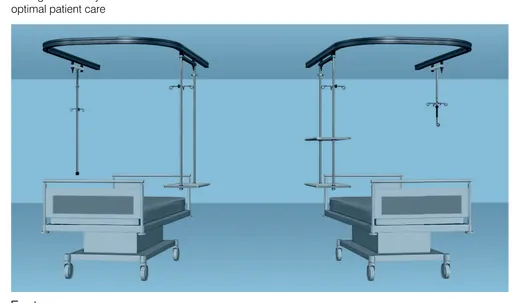
Ceiling rails solve a specific problem: equipment that must follow the patient along the bed without being lifted, unplugged or wheeled. Infusion sets, perfusors and monitors hang from carriers that slide along the rail, so a bed can be moved, raised or rotated without the equipment having to be relocated separately.
The secondary benefits are just as valuable. Nothing stands on the floor, so wet cleaning between patients is quick and complete. Nothing trails across the floor, so trip hazards disappear. And ground clearance under the bed improves, which matters for both cleaning and for the range of motion of modern beds. Tecnomed supplies the Uni ceiling hanging system TEC81.20 and the IO ceiling suspension system TEC81.30 for this purpose.
Rail types, carriers and travel
The Uni system uses a curved hanger rail, supplied at approximately 2100 by 1400 mm in its standard U, L or O configurations with two end caps and three connectors, and other sizes are available down to a minimum 1200 mm width determined by the radius. The IO system uses straight rails up to 6000 mm long, with parallel and link rails for larger layouts.
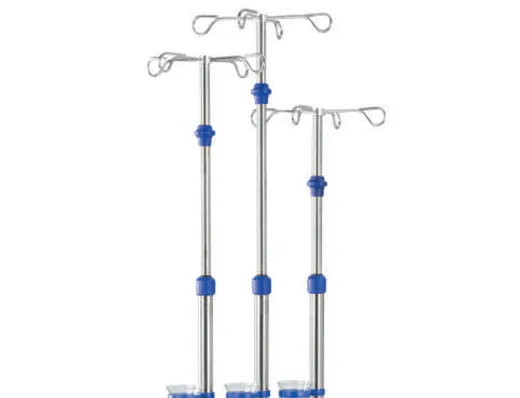
Carriers are what the equipment hangs from. The Tecnomed serum carrier TEC81.20.02 is stainless steel with five hooks and one-handed height adjustment, the infusion carrier TEC81.20.03 has a 1750 mm pipe length, and the dual infusion carrier TEC81.20.04 carries eight hooks in two groups of four at 2 kg per hook. All run on eight silent bearings, which is what keeps a loaded carrier moving smoothly and quietly beside a sleeping patient.
- Uni system hanger rail TEC81.20.01: anodised aluminium, curved U, L or O layouts
- IO system hanger TEC81.30.01: straight rails up to 6000 mm
- Profile size 57.5 by 47.5 by 5 mm on both systems
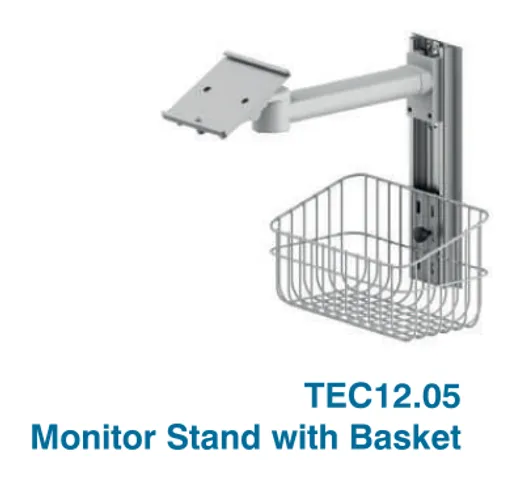
- Serum, infusion, dual infusion and monitor carriers
- Eight silent bearings per carrier with one-handed height adjustment
Load capacity and structural fixing
Both Tecnomed systems are rated at a maximum of 80 kg per metre, with the IO system quoted at 80 kg per 1000 mm and a total carrier load of 80 kg. Individual carriers have their own ratings: the serum carrier at 15 kg total, the infusion carriers at 40 kg total with 2 kg per hook, and the monitor carrier at 80 kg. Design to the carrier rating and the rail rating together, not to one alone.
Fixing is to the structural slab, never to a suspended ceiling grid. Drop rods or brackets are anchored into the slab at spacings determined by the rail section and the design load, and in refurbishment the anchor type must be selected for the slab construction actually present. Have the fixing designed and signed off by an engineer, and record the anchor positions before the ceiling is closed.
Coordinating with pendants, lights and HVAC
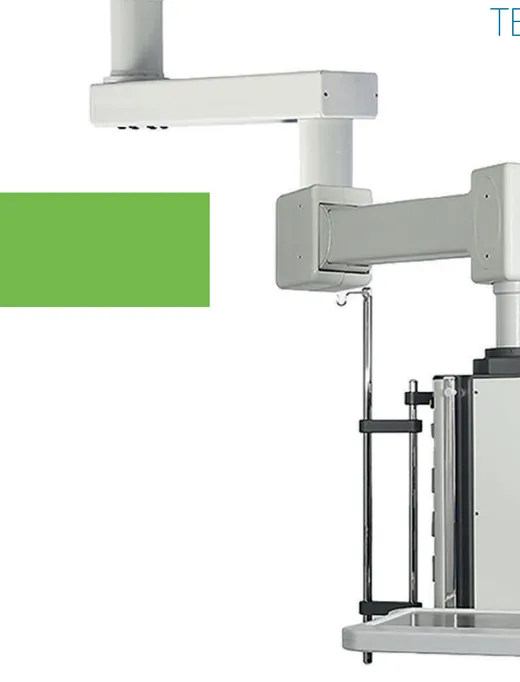
The ceiling is the most congested plane in a hospital room. Rails compete for space with pendant flanges, examination and surgical lights, supply and extract diffusers, sprinkler heads, general lighting and ceiling-mounted hoists. Each of these has its own clearance requirement, and each is expensive and disruptive to move once it has been installed.
Produce one coordinated reflected ceiling plan showing every element, and check the swept paths as well as the static positions: a pendant arm must be able to rotate through its envelope without striking a rail or a carrier. In theatres, also check how rails and carriers interact with the laminar flow field, since anything suspended in it disturbs the airflow and must be agreed with the ventilation designer.
Ceiling rail versus wall-mounted services
Wall-mounted services are cheaper, simpler and entirely adequate for most ward beds. A bed head unit with an accessory rail carries monitors and pumps well, needs no structural work and can be installed late in the programme. Where the bed does not move much, that is the right solution and a ceiling rail adds cost without adding function.
Ceiling rails earn their cost where the bed moves, where access is needed from all sides, where floor cleaning is critical, or where the wall behind the bed is glazed or otherwise unusable. Intensive care, isolation rooms and high-dependency areas are the usual cases. Most hospitals end up with both: bed head units on wards, rails and pendants in critical care.
Cleaning, infection control and maintenance access
Anodised aluminium rails and stainless steel carriers withstand routine disinfection without degrading, which is the first requirement. The second is that the rail profile should not create an open channel that collects dust where it cannot be reached. Ask how the rail is cleaned in practice and at what height, because a rail that needs a ladder will not be cleaned as often as one that can be reached from the floor.
Maintenance access should be planned as well. Carrier bearings, brakes and height adjustment mechanisms need periodic checking, and rail end caps and connectors should be removable without dismantling the whole run. Tecnomed designs the Uni and IO systems for maximum freedom of movement for maintenance personnel, with rails that can be mounted at different levels to suit the room.
Planning checklist for new build and retrofit
New build lets rails be planned with the structure, which is always cheaper. Retrofit is possible but constrained by the slab, the existing services in the void and the ceiling height already established. In both cases the checklist is the same, and in both cases the survey comes before the order.
Order the rail only after the structural survey and the coordinated ceiling plan are both signed off. Rails are cut and configured to the layout, so a change of route after manufacture means new sections and new connectors. Confirming the bed positions with the clinical team one final time before release is a few minutes well spent.
- Rail layout agreed with the clinical team against the bed positions actually used
- Rail type and length: curved Uni layout or straight IO run
- Carrier types and quantities per bed, with their individual load ratings
- Total design load per metre against the 80 kg/m rail rating
- Structural survey of the slab and engineered anchor design
- Coordinated reflected ceiling plan including pendants, lights, diffusers and sprinklers
- Swept path checks for pendant arms and light arms against the rail
- Cleaning method and maintenance access to carriers, bearings and end connectors
Frequently asked questions
How much load can a hospital ceiling rail carry?
Tecnomed Uni and IO systems are rated at a maximum of 80 kg per metre, with the IO hanger quoted at 80 kg per 1000 mm. Individual carriers have separate ratings, for example 15 kg for the serum carrier and 40 kg for the infusion carriers at 2 kg per hook, so design to both figures.
Can ceiling rails be fitted to an existing hospital room?
Yes, provided the structural slab can accept the anchors and there is space in the ceiling void. A structural survey of the actual slab construction is essential, and the rail must be fixed to structure rather than to the suspended ceiling grid. Existing services in the void usually dictate the achievable layout.
Ceiling rail or bed head unit rail: which should we choose?
Bed head unit rails are cheaper and adequate where the bed stays in one place, which covers most ward beds. Ceiling rails are worth the cost where the bed moves, where access is needed from all sides, where floor cleaning is critical or where the wall behind the bed cannot be used.
Do ceiling rails interfere with pendants and surgical lights?
They can, which is why a single coordinated reflected ceiling plan is essential. Check swept paths as well as static positions, so that pendant and light arms can rotate through their full envelope without striking a rail or a loaded carrier, and agree anything suspended in a laminar flow field with the ventilation designer.