Types of IV pole used on wards and in ICU
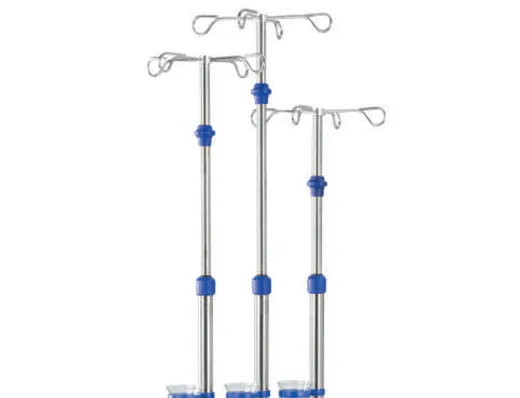
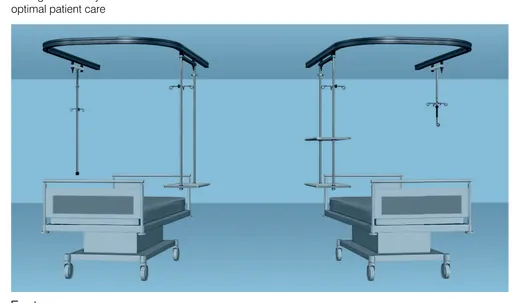
Three types cover most hospital needs. Mobile infusion stands on castors are the general purpose item used on wards and in outpatient areas. Patient walker versions are built to be leaned on and pushed while the patient walks, which requires a heavier base and a more rigid pole. Bed-mounted and rail-mounted poles travel with the bed or fix to a bed head unit or ICU rail.
Tecnomed manufactures the intertwinement type serum trolley TEC81.01 and the intertwinement type patient walker TEC81.02, both in stainless steel with a weighted base, and supplies rail-mounted serum hangers and IV posts as part of the TEC12 intensive care accessory range and on its vertical and bridge ICU units. In practice a hospital needs a mix rather than one universal pole.
Base design, castors and stability
Stability is a geometry problem. A wide base resists tipping but catches on door frames and bed wheels; a narrow base moves easily but becomes unstable once a pump is mounted high on the pole. The practical answer is a weighted base of moderate diameter that keeps the centre of gravity low. The Tecnomed base measures 630 by 620 mm and is weighted for that reason.
Castors matter as much as the base. Four 75 mm twin castors, braked and electrostatic, roll over thresholds and cable covers, resist thread and hair wrapping better than single wheels, and can be locked when the pole is parked. Test any candidate pole the way it will actually be used: load it with the heaviest pump combination on the ward and push it over a door threshold.
- Weighted base to keep the centre of gravity low under a loaded pole
- Base footprint wide enough for stability yet able to pass through doorways
- Twin castors of at least 75 mm, braked and electrostatic
- Smooth rolling over thresholds, cable covers and lift entrances
- Tested loaded, not empty, before a bulk order is placed
Height adjustment and hook configurations
Height adjustment must be operable with one hand, because the other hand is holding the line, the bag or the patient. A collar or clamp that needs two hands and a firm grip will be left at the wrong height. An integrated extension limiter is equally important: it prevents the pole being raised beyond its stable range, which is the usual cause of tipping.
Hook configuration determines how many infusions the pole can carry without bags fouling each other. Four stainless steel hooks arranged at 90 degrees to each other, as on the Tecnomed TEC81.01 and TEC81.02, keep lines separated and allow the pole to be approached from any side. Each hook should have a stated capacity; the Tecnomed hooks are rated at 2 kg each.
Carrying infusion pumps and accessories
The moment a pole carries pumps it becomes a different product. Two or three pumps mounted at chest height move the centre of gravity upward and outward, so the pole must be rigid enough not to flex and the base heavy enough not to lift. The Tecnomed TEC81.02 patient walker has an integrated foot weight specifically for secure mounting of infusion pumps and other devices.
Decide where devices will actually be clamped before choosing the pole, and check that the pole diameter matches the clamps the hospital already owns. Retrofitting pumps designed for a different pole diameter is a common and avoidable frustration. If syringe drivers, feed pumps and a small monitor may all appear on the same pole, test that combination rather than a single pump.
Materials, coatings and cleanability
Stainless steel is the material of choice for the pole and hooks because it survives repeated disinfection without pitting or flaking, and because a damaged surface can be cleaned rather than having to be replaced. Tecnomed uses stainless steel pipes in accordance with DIN EN 10217-7, with stainless hooks and a screw-in stainless bottle holder.
Chrome-plated steel is cheaper but the plating eventually chips, and once moisture reaches the base metal the pole rusts from the inside of the chip outward. That matters clinically as well as cosmetically, since a pitted surface cannot be reliably disinfected. Plastic components should be UV stable so they do not become brittle in a day room with large windows; Tecnomed moulds its plastic parts in blue and specifies them as sunlight resistant.
Storage and nesting to save space
Storage is the requirement most often ignored at purchase and most often complained about afterwards. Every ward has more poles than it has space, and poles parked in corridors are both a fire hazard and an infection control problem. Nesting geometry, where the legs of one pole interlock with the next, is what solves it.
The Tecnomed intertwinement leg structure is designed for this and saves up to 72 percent of the storage space required by conventional infusion stands. The compact design also prevents loss or disassembly of individual components, which is the other chronic problem with ward poles. When comparing products, ask how many poles fit in one square metre when nested, not what a single pole costs.
Procurement checklist
Specify IV poles the way you would specify any other item of patient-contact equipment, and buy a small trial quantity for the busiest ward before committing to a hospital-wide order. Staff will identify a stiff height adjustment or an awkward castor within a week, long before a datasheet comparison would have revealed either problem.
Include the ward housekeeping team in the trial as well as the nursing staff. They are the people who move, clean and store the poles, and they will tell you immediately whether the nesting works in the space actually available and whether the base can be cleaned around without being lifted, which are the two questions that decide long-term satisfaction.
- Pole type required per area: general infusion stand, patient walker, rail or bed mounted
- Number of hooks, their arrangement and stated capacity per hook
- Total load required including pumps, drivers and any monitor
- Base dimensions, weighting and doorway clearance
- Castor size, type, braking and electrostatic specification
- One-hand height adjustment with extension limiter
- Pole diameter matched to existing device clamps
- Material specification, including the stainless steel standard
- Nesting geometry and storage density when nested
- Availability of spare castors, hooks and collars
Frequently asked questions
Stainless steel or chrome plated: which is better for IV poles?
Stainless steel. Chrome plating eventually chips, and once moisture reaches the base metal corrosion spreads under the plating and the surface can no longer be reliably disinfected. Tecnomed poles use stainless steel pipes to DIN EN 10217-7 with stainless hooks and bottle holder.
How much weight can an IV pole carry?
It depends on the hook rating and the base. Tecnomed hooks are rated at 2 kg each with four hooks arranged at 90 degrees. What limits a pole in practice is stability with pumps mounted high, so always test the intended pump combination rather than relying on a total load figure.
Why does nesting matter when choosing IV poles?
Because storage space is the constraint on every ward. The Tecnomed intertwinement leg structure allows poles to interlock and saves up to 72 percent of the storage space needed by conventional stands, which keeps corridors clear and reduces the fire and infection control problems caused by parked equipment.
Do we need a different pole for patients who walk with their infusion?
Usually yes. A patient walker is built to be leaned on and pushed, so it needs a heavier, weighted base and a more rigid pole than a standard infusion stand. The Tecnomed TEC81.02 patient walker includes an integrated foot weight for secure mounting of pumps and devices.