Why medical gas alarms are mandatory
A medical gas pipeline is invisible in use. Staff see a probe click into an outlet and gas flow; they do not see a manifold approaching changeover, a regulator drifting high or a compressor tripping. The alarm system is the only mechanism that makes the state of the supply visible before a clinical failure occurs.
That is why EN ISO 7396-1 and HTM 02-01 treat alarms as part of the supply system rather than an accessory. Both high and low pressure conditions are treated as high priority: low pressure threatens the patient directly, while high pressure indicates a regulator failure that can damage equipment and create a downstream hazard.
Plant alarms, operating alarms and area alarms
Plant or source alarms come from the supply equipment itself: manifold changeover, low cylinder contents, liquid oxygen tank level, PSA oxygen purity below limit, compressor or vacuum pump fault, dryer failure and reserve in use. These are directed at the estates department and the authorised person, because they require technical action.
Area alarms monitor the pipeline pressure in a clinical zone, downstream of the area valves, and are directed at the clinical staff in that zone. Operating alarms sit in between and cover conditions such as plant running on standby or a filter needing change. A single hospital will have many area alarms and a smaller number of plant alarm panels.
- Source alarms: changeover, low contents, reserve in use, purity and plant fault
- Operating alarms: duty and standby status, filter and dryer condition, running hours
- Area alarms: high and low pipeline pressure per gas in each clinical zone
- Vacuum alarms: low vacuum level as well as plant fault
Pressure thresholds and signal types
Each gas has a nominal distribution pressure, typically around 4 bar for patient gases and 7 bar for surgical air, and alarm thresholds are set as a band around it. The low threshold is set high enough to give warning before clinical equipment is affected, and the high threshold low enough to catch a failed regulator before downstream components are stressed. Vacuum is monitored for insufficient vacuum rather than pressure.
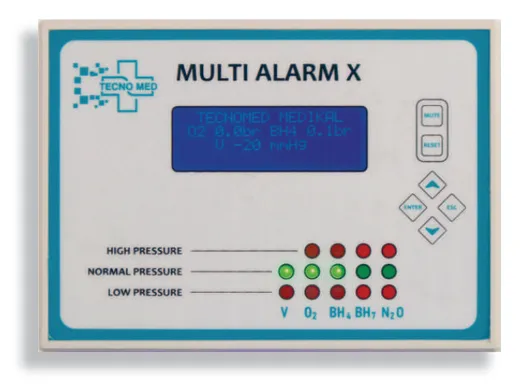
The Tecnomed Multi Alarm X provides two alarms per monitored gas, high pressure and low pressure, both classified as high priority, with high, normal and low LED indication per service alongside the LCD display of actual pressure values. Mute and reset keys are on the front panel, and muting an audible alarm must never clear the visual indication, which stays until the condition itself is resolved.
Where panels must be located and who monitors them
The governing rule is that every alarm must reach somewhere permanently staffed. In practice that means the switchboard, a 24-hour estates control room or a nursing station that is never left unattended. A panel in a plant room that nobody visits at night satisfies nothing, however good the panel is.
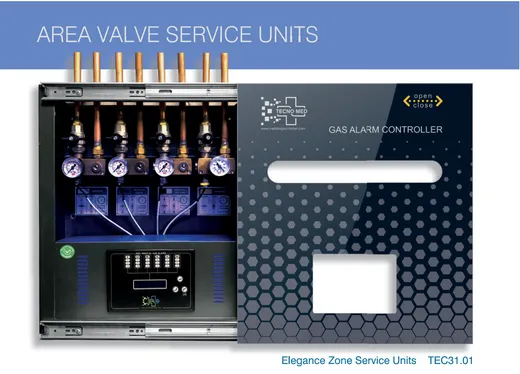
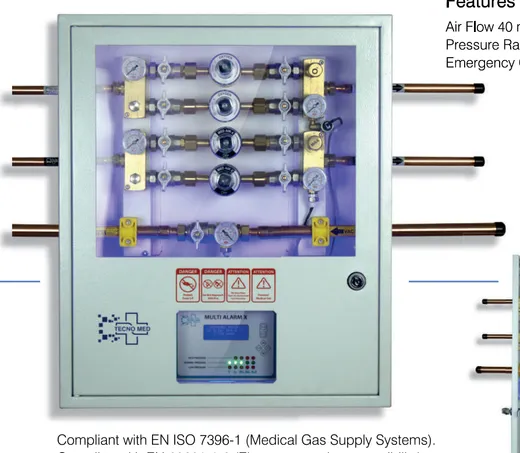
Area alarm panels belong in the zone they monitor, typically at the nursing station or beside the area valve service unit, where the staff who would act on them can see them. Tecnomed fits the Multi Alarm X into zone control units and regulator panels, or supplies it as a standalone area alarm, so the same display and the same operating logic is used throughout the hospital.
Wiring, sensors and BMS integration
Sensors are installed in the pipeline at the point being monitored, with an isolating valve so a sensor can be replaced without shutting the zone. Cabling should be run separately from mains power, on a supply that survives a mains failure, and monitored so that a broken cable produces a fault indication rather than a silent loss of monitoring.
Integration with the building management system is now routine rather than optional. The Multi Alarm X transmits pressure values, current limit settings and alarms over RS485 Modbus, which lets the estates team trend pressures, see how often a manifold changes over and identify a drifting regulator before it alarms. Integration supplements the dedicated alarm panels; it never replaces them.
Commissioning and periodic testing
At commissioning, every alarm condition is simulated at the sensor and verified at every panel that should display it, including the remote and BMS destinations. Thresholds are confirmed against the design values, audible levels are checked against background noise in the actual room, and the mute and reset behaviour is confirmed. The results are recorded per alarm point, not per system.
Periodic testing follows the hospital's planned maintenance regime under HTM 02-01, with a documented schedule, named responsibilities and retained records. A rolling programme that tests a proportion of alarm points each quarter is usually more effective than an annual exercise, because it keeps both the equipment and the staff response current.
Documentation and staff training
An alarm nobody understands is not a safety system. Staff in each zone should know what their panel monitors, what a low pressure alarm on each gas means clinically, what immediate action to take, and who to call. Print the escalation path beside the panel rather than relying on a policy document in a folder.
Keep the alarm point schedule as a living document rather than a handover artefact. Every time a zone boundary changes, an outlet is added or a plant item is replaced, the schedule and the response procedures must be updated and the affected staff told. An out-of-date schedule is how a hospital ends up with alarms nobody can trace to a physical location.
- Schedule of every alarm point, its sensor location, thresholds and the panels it reports to
- Commissioning test records for each alarm condition at each display location
- Written response procedure for low and high pressure per gas, displayed at the panel
- Escalation contacts including estates, the authorised person and the switchboard
- Training records for clinical staff and for the estates team
- Planned maintenance schedule with retained test results
Frequently asked questions
What is the difference between an area alarm and a plant alarm?
An area alarm monitors pipeline pressure in one clinical zone and is aimed at the staff working there. A plant alarm reports the condition of the supply system, such as manifold changeover or a compressor fault, and is aimed at the estates department and the authorised person for medical gases.
Why is high pressure treated as a high priority alarm?
Because it indicates that a regulator has failed. Excess pipeline pressure can damage terminal units, flowmeters and ventilators, and can deliver gas at a pressure the downstream equipment was not designed for. Both high and low pressure alarms are classified as high priority on the Multi Alarm X.
Can medical gas alarms be connected to the building management system?
Yes, and it is good practice. The Multi Alarm X transmits pressure values, limit settings and alarm states over RS485 Modbus for trending and reporting. BMS integration supplements the dedicated alarm panels but does not replace the requirement for audible and visual indication at a continuously staffed location.
How often should medical gas alarms be tested?
Fully at commissioning, with every condition simulated and verified at every display location, then periodically under the hospital's documented maintenance regime in line with HTM 02-01. A rolling quarterly programme covering a share of alarm points keeps both equipment and staff response current.