What a medical pendant is used for
A medical pendant is a ceiling-mounted supply unit that brings medical gas outlets, electrical sockets, earthing points, data connections and equipment mounting surfaces to a point above the patient. It removes trailing hoses and cables from the floor, which improves both cleaning and safety, and it lets the service point move with the clinical activity rather than staying fixed to a wall.
In an operating theatre that usually means two pendants: one carrying anaesthetic gases, suction and monitoring for the anaesthetist, and one carrying power and data for surgical equipment towers. In intensive care it usually means one pendant per bed carrying the full service set, or a pendant paired with a bed head unit.
Single arm, double arm and rigid configurations
A rigid pendant is a fixed column with no arms. It is the simplest and most robust option and suits positions that never move, such as dialysis bays, sampling rooms and fixed intensive care bed positions. A single arm double joint pendant adds one horizontal arm with two articulated joints, which lets the head swing around the bed within a controlled radius.
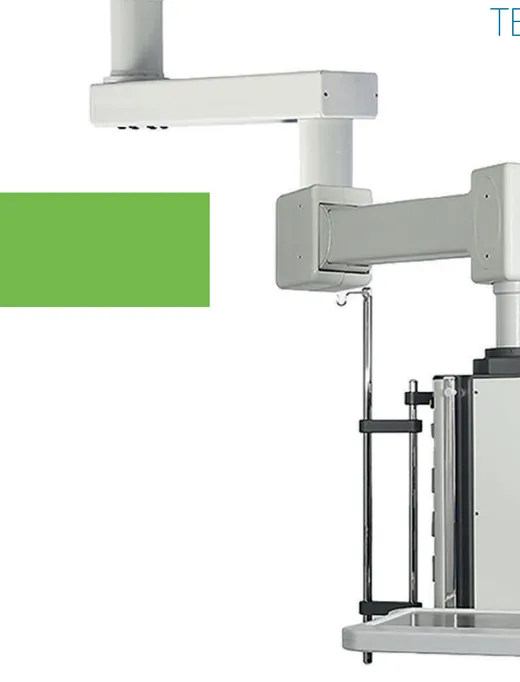
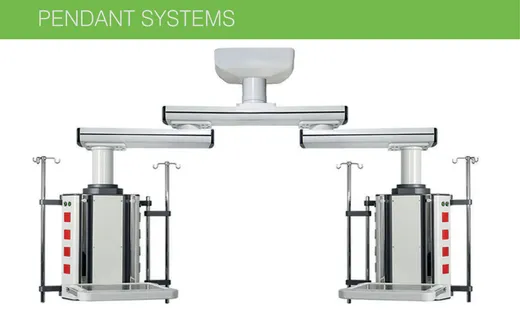
A double arm three joint pendant adds a second arm and a third joint, giving the widest working radius and the ability to fold the head back against the wall when it is not in use. Tecnomed also builds a twin pendant, where two independent service heads hang from a single ceiling mount, each with its own arm and brakes, so wet and dry services can be separated or two bed spaces served from one fixing point.
- Rigid pendant: fixed position, minimal moving parts, lowest maintenance
- Single arm double joint: controlled swing around one bed, compact ceiling footprint
- Double arm three joint: widest reach, parks clear of the working area
- Twin pendant: two independent heads on one ceiling mount
Load capacity: what the figures really mean
Load capacity is the mass the service head and its shelves can carry with the arm fully extended, which is the worst case for the ceiling fixing and the arm bearings. Tecnomed pendants carry 90 kg as standard and can be built to 180 kg as a customised configuration. A figure quoted without stating the arm position is not usable for design.
Count the real load rather than assuming. A patient monitor, two or three infusion pumps, a syringe driver, a ventilator shelf and the hoses themselves add up quickly, and in an operating theatre an equipment tower on a pendant shelf can dominate the total. Then leave margin: a pendant installed today will be carrying devices that do not yet exist when it reaches mid-life, and upgrading capacity after the ceiling is closed is expensive.
Arm reach and rotation angles: the working envelope
Reach is the horizontal distance from the ceiling flange to the centre of the service head with the arms extended. Rotation is how far each joint can turn. Multiplying the two gives the working envelope, which is the area over which the head can actually be positioned. This is the figure to check against the room layout, not the arm length alone.
Draw the envelope on the room plan at the design stage, with the bed or table in every position the clinical team uses, including the rotated position used for imaging or airway access. Check that the head clears the surgical light, the ceiling supply diffusers and any ceiling rail. Colour-coded brake buttons and knuckles on Tecnomed pendants let staff release the correct joint without hunting for the right control during a procedure.
Services to plan: gases, power, data and shelves
Tecnomed pendants come with eight electrical sockets and eight grounding points as standard, in UK, USA or European pattern, plus two rail racks for mounting accessories. Medical gas outlets are supplied in BS 5682, DIN 13260-2 or AFNOR NF S 90-116 pattern to match the hospital pipeline, and pressure gauges for the gas services can be added on the head.
Shelves, drawers, IV poles and data socket covers are the options that turn a service head into a workstation. Decide early how many shelves are needed and at what spacing, because shelf positions affect the centre of gravity and therefore the load calculation. Also decide which sockets are on the uninterruptible supply and mark them clearly, so that life-supporting equipment is never plugged into a normal mains outlet by mistake.
Operating room versus ICU requirements
Operating theatres need reach and the ability to park the head completely clear of the sterile field. They usually need higher surgical air provision at 7 bar, anaesthetic gas scavenging, and more data connections for imaging and video. Double arm three joint pendants dominate here, often in pairs, and brake performance matters because the head is repositioned repeatedly during a list.
Intensive care needs capacity and reliability more than reach. The head tends to stay in one general area for days at a time, carrying a heavy and stable load of pumps and monitors. Single arm pendants, twin pendants serving two bays, and rigid pendants at fixed bed positions are all common, and height adjustment is valued for ergonomics rather than for rapid repositioning.
Specification checklist
A pendant specification that answers the following points can be priced accurately and installed without change orders on site. Issue it together with a reflected ceiling plan showing the proposed flange position and the structural slab level, because the structural interface is where most pendant projects run into trouble once work begins.
Ask for the working envelope to be drawn by the supplier against your room layout rather than described in words, and ask for the load figure to be confirmed at full arm extension. Those two responses tell you quickly whether a bidder has read the room or is quoting a catalogue item, and they are the details that decide clinical satisfaction after handover.
- Room type, ceiling height and slab-to-finished-ceiling dimension
- Arm configuration and required reach, with the working envelope drawn on plan
- Load capacity required at full extension, with the device schedule that justifies it
- Gas services, quantities and terminal unit standard
- Socket count and pattern, split between mains and uninterruptible supply
- Grounding points, data outlets and any video or imaging connections
- Shelves, drawers, IV poles and rail accessories required
- Brake type: standard, electromagnetic or pneumatic
- Height adjustment: motorized or fixed
Frequently asked questions
How much load capacity should a medical pendant have?
Enough for the full device schedule at full arm extension, with margin for future equipment. Tecnomed pendants carry 90 kg as standard and can be built up to 180 kg as a customised configuration. Always confirm that a quoted figure applies with the arms fully extended, not folded.
Single arm or double arm: which do I need?
Single arm double joint pendants suit intensive care beds and smaller rooms where the head moves within a limited radius. Double arm three joint pendants give a much wider working envelope and can park clear of the sterile field, which is why they are the usual choice for operating theatres.
Can a pendant carry the same gas outlets as our existing pipeline?
Yes. Tecnomed pendants are supplied with medical gas outlets in BS 5682, DIN 13260-2 or AFNOR NF S 90-116 pattern. Match them to the rest of the hospital so that probes, flowmeters, regulators and hoses remain interchangeable between pendants, bed head units and wall outlets.
What is a twin pendant used for?
A twin pendant carries two independent service heads from one ceiling mount, each with its own arm and brake system. It is used to separate wet and dry services at a single workstation, or to serve two adjacent bed spaces where the ceiling offers only one suitable fixing point.