The three ways hospitals get oxygen: cylinders, LOX and on-site generation
Cylinder manifolds are the starting point. They need no power, install quickly and work anywhere, but consumption of more than a few cylinders per day turns into a logistics burden and a storage problem. They remain essential as reserve supply even when a larger source is installed, so almost every hospital keeps a manifold room whatever else it builds.
Bulk liquid oxygen is the traditional answer for large hospitals. A vacuum-insulated cryogenic tank holds oxygen as a liquid at around minus 183 degrees Celsius, and ambient air evaporators turn it back into gas on demand. On-site generation with a pressure swing adsorption plant is the third route: it produces oxygen continuously from the air in the plant room, using electricity instead of deliveries.
How a PSA oxygen generator produces oxygen
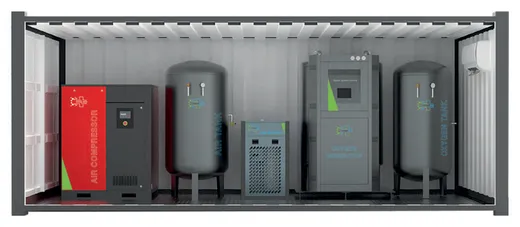
A compressor feeds dried, filtered air into vessels packed with a zeolite molecular sieve. Under pressure the sieve adsorbs nitrogen and lets oxygen pass. When the first vessel approaches saturation, the plant switches to the second vessel and depressurises the first, which releases the trapped nitrogen to atmosphere. Alternating the two vessels gives a continuous oxygen stream, which is why the process is called pressure swing adsorption.
Oxygen leaves the sieve beds at high purity, is buffered in a receiver and is then reduced to pipeline pressure. An oxygen analyser continuously monitors concentration and diverts or alarms if purity falls below the set limit. Tecnomed supplies containerised PSA oxygen generator systems across a wide capacity band, from small district hospital duties up to large installations, and can add a cylinder filling station so the hospital fills its own portable cylinders.
How a liquid oxygen installation works
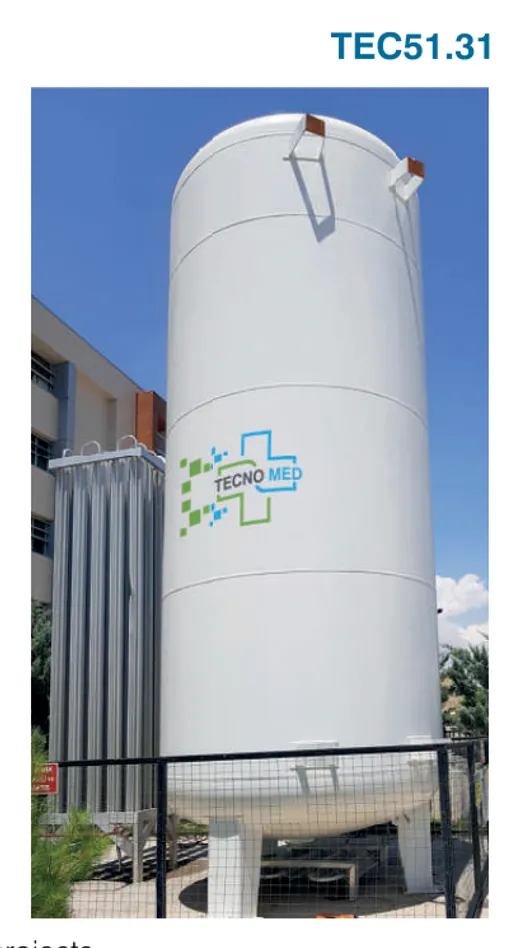
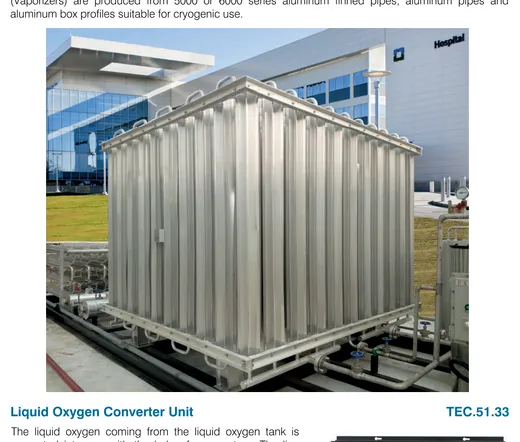
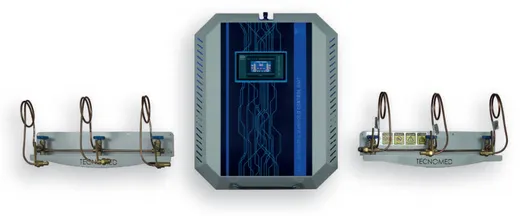
A cryogenic vessel stores liquid oxygen under modest pressure in a vacuum-insulated inner tank. Liquid is drawn off, passed through finned aluminium ambient air evaporators that absorb heat from the surrounding air, and leaves as gas at high pressure. A converter unit then reduces that pressure to the pipeline value, typically bringing around 15 bar down to the 4 to 5 bar the hospital distribution needs.
Tecnomed manufactures cryogenic tanks to EN 13458-2 and PED 2014/68/EU together with matching evaporators and converter units, including duplicated evaporator and regulation paths so one line can be isolated for de-icing or maintenance while the other carries the load. Because heat leak is never zero, a tank that is not being used steadily will vent gas through its relief valve, which is a real consideration for smaller hospitals.
Comparison: capacity, purity, footprint, logistics and redundancy
Liquid oxygen wins decisively on stored volume for a given footprint, since one cubic metre of liquid yields several hundred cubic metres of gas. It also delivers pharmaceutical-grade oxygen straight from the vessel. PSA plants deliver oxygen at slightly lower concentration than liquid supply because argon remains with the oxygen, which is accepted for oxygen 93 percent as a pharmacopoeia product but must be stated in the tender and accepted by the clinical team.
Logistics is usually the deciding factor. A LOX tank is only as reliable as the road to it, and hospitals in remote regions, islands or areas with unstable supply chains have learned that the hard way. A PSA plant depends instead on electricity, which the hospital already backs up with generators. Both arrangements need a cylinder manifold reserve, so neither removes the need for a manifold room.
- Stored autonomy: LOX gives days of supply in one vessel; PSA gives continuous output but small buffer storage
- Purity: LOX supplied as medicinal oxygen; PSA produces oxygen 93 percent with residual argon
- Footprint: LOX needs an outdoor compound with exclusion distances; PSA needs a ventilated plant room or container
- Dependency: LOX depends on deliveries, PSA depends on power and compressor maintenance
- Both require an independent reserve supply under EN ISO 7396-1
Operating cost and energy considerations
The cost structures are genuinely different in shape. Liquid oxygen is dominated by the delivered product and by rental or evaporation losses, so cost scales almost linearly with consumption and is exposed to supplier pricing. A PSA plant converts most of its cost into electricity for the air compressor, plus periodic filter, dryer and sieve maintenance, so cost is dominated by capital and kilowatt-hours the hospital already controls.
Air compressors are the energy centre of a PSA installation, and oversizing them is the most common design error. Size the plant on realistic peak demand with diversity applied, not on the sum of every outlet, and confirm the plant can modulate or stage down at night. Comparing options honestly means putting capital, energy, maintenance and delivery on the same ten-year footing rather than comparing purchase prices.
Regulatory and backup supply requirements
EN ISO 7396-1 and HTM 02-01 require primary, secondary and reserve supplies whatever the technology. For a PSA installation that typically means duplicated generation trains plus a cylinder manifold reserve. For a LOX installation it usually means a main tank, a secondary tank or backup vessel, and again a manifold reserve with automatic changeover.
Both sources need continuous monitoring of pipeline pressure and, for PSA, of oxygen concentration, with high-priority alarms repeated at a permanently staffed location. Plan the documentation early: material certificates, pressure equipment certification for cryogenic vessels, purity test records and a validated commissioning file are all part of handover, not optional extras.
Decision guide by hospital size and location
Small hospitals and clinics with modest oxygen demand are usually best served by a manifold, or by a compact PSA plant with manifold reserve where deliveries are unreliable. Mid-size district hospitals frequently choose PSA because it removes the delivery dependency without needing a cryogenic compound. Large tertiary hospitals with sustained high flows, and any site with intensive care beds in the dozens, generally justify liquid oxygen with a strong reserve.
Geography overrides size more often than planners expect. If the supplier route can be cut by weather, borders or fuel shortages, on-site generation is the safer architecture even at higher capital cost. If a reliable industrial gas supplier is nearby and demand is high and steady, liquid oxygen remains the lowest-friction solution. Tecnomed manufactures both, along with the evaporators, converter units and manifolds that complete either design.
Frequently asked questions
Is PSA oxygen good enough for patient use?
Yes, where the project specifies oxygen 93 percent, which is a recognised pharmacopoeia product. PSA oxygen contains residual argon, so concentration is lower than liquid supply. The plant must monitor concentration continuously and alarm if it drops below the set limit, and the clinical team should confirm acceptance at design stage.
Can a PSA oxygen generator fill cylinders?
Yes. A high-pressure booster and filling ramp can be added so the hospital fills its own portable cylinders for transport, wards and ambulances. Tecnomed offers cylinder filling as part of its containerised oxygen generator systems, which also reduces dependence on outside cylinder deliveries.
Do we still need a cylinder manifold if we install LOX or PSA?
Yes. EN ISO 7396-1 requires an independent reserve supply regardless of the primary source. In practice that is an automatic cylinder manifold with changeover, sized to carry the hospital through a plant failure or maintenance shutdown until the main source is restored.
Which option has the lower running cost?
It depends on consumption and local prices. Liquid oxygen cost scales with delivered volume and supplier pricing. PSA cost is mostly electricity and scheduled maintenance. Compare them over at least ten years including capital, energy, service and the cost of any supply interruption, rather than on purchase price alone.