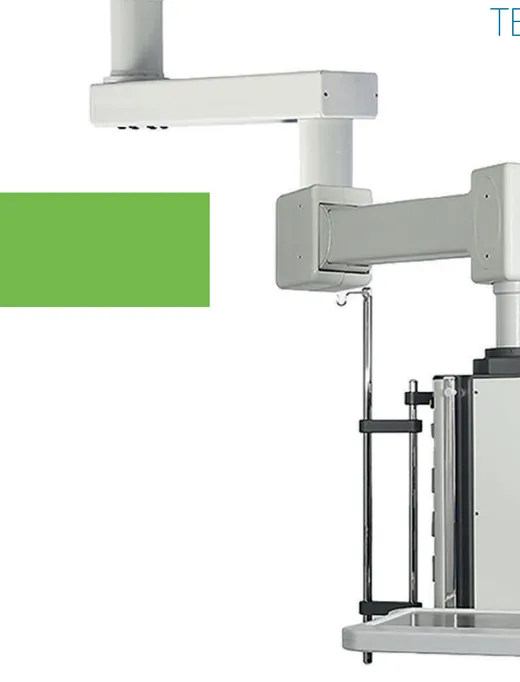
How height adjustment works in each type
In a motorized pendant, a linear actuator or lifting column inside the vertical member raises and lowers the service head through a defined travel. Controls are usually on the head itself, so a nurse or anaesthetist adjusts the working height without leaving the bedside. The travel is limited by end stops and the drive holds position when the power is removed.
A non-motorized pendant has no powered column. The service head is set at a fixed height determined at installation, and repositioning is done horizontally through the arm joints. Some designs use counterbalanced or gas-spring arms to allow a degree of vertical movement, but the principle is the same: mechanical rather than electrical adjustment.
Motorized pendants: travel, control and safety features
Tecnomed offers motorized single arm double joint and motorized double arm three joint pendants, both with electrical height adjustment of the service head and the same standard package of eight electrical sockets, eight grounding points and two rail racks. Load capacity is 90 kg as standard, and up to 180 kg as a customised build, with the powered column sized accordingly.
Safety features are what separate a good motorized pendant from a poor one. Look for end-of-travel limits, an overload cut-out, retention of position on power loss and controls that cannot be operated accidentally. Electromagnetic and pneumatic brake systems are available as an option on Tecnomed pendants and are worth specifying where the head is repositioned frequently during procedures.
Manual and fixed-height pendants
The non-motorized single arm double joint and double arm three joint pendants carry exactly the same service package as their motorized counterparts, with the same 90 kg standard capacity and the same choice of BS, DIN or AFNOR gas outlets. What they lack is the powered column, and with it a motor, a controller, a cable route through the arm and a component that can eventually fail.
That simplicity is a genuine engineering advantage in some settings. A rigid ceiling pendant, with no arms and no joints at all, is the most robust member of the family and is entirely appropriate for dialysis rooms, sampling rooms, laboratories and intensive care bays where the bed position is fixed. Specifying motorized adjustment for such a room adds cost without adding clinical value.
Clinical workflow and ergonomics
Height adjustment earns its cost where the same service head is used by staff of very different statures, where the head carries equipment that must be read at eye level, and where the bed height itself changes during a procedure. Anaesthetic workstations and high-dependency intensive care bays are the usual examples. Being able to drop a monitor to eye level for a seated clinician and raise it out of the way afterwards is a real workflow gain.
Where the equipment is set up once per shift and left alone, the benefit is marginal. Ask the clinical team how many times a day they would actually change the height. If the honest answer is once or twice, a fixed-height pendant with a well-chosen mounting height will serve the unit just as well and remove a maintenance item.
Maintenance, spare parts and downtime
A motorized column is a serviceable assembly with a finite life. Plan for actuator inspection, control checks and eventual replacement, and confirm at purchase how long spare columns and controllers will be available. Downtime matters more than the part cost: an intensive care bay out of service for a week while a component is shipped is far more expensive than the component itself.
Manual pendants concentrate their wear in the joints and brakes. Brake pads, friction discs and bearing surfaces are consumables, and colour-coded brake buttons make it easy for staff to report which joint is slipping. Either way, hold a small stock of brake and sealing parts locally rather than relying on air freight for routine items.
Budget and total cost of ownership
On purchase price, the order is predictable: rigid is cheapest, then non-motorized single arm, non-motorized double arm, motorized single arm and motorized double arm. Over ten years the gaps narrow, because the arms, service head, ceiling reinforcement and service routing cost the same in every case and only the lifting column differs.
The decision that actually moves the budget is quantity and mix. Specifying motorized pendants for every bay in a twenty-bed unit when only the six highest-acuity bays need them is a common and avoidable overspend. A mixed specification, with motorized units where the clinical case is clear and fixed-height or rigid units elsewhere, usually delivers better value than a single uniform choice.
Which type for which room
Match the pendant to the work done in the room rather than to the department name on the door. The rule of thumb is that motorized adjustment pays where the head is shared between staff, repositioned often and read at close range, and that fixed height pays where the head is set once and then loaded heavily for days at a time.
Review the list with the clinical team before it goes into the tender, because the people who will use the pendant every shift are the ones who know how often the height actually changes. A mixed specification across a department is normal and usually cheaper than a uniform choice, provided the gas standard and socket pattern stay identical throughout.
- Operating theatre anaesthetic position: motorized double arm three joint
- Operating theatre surgical equipment position: motorized or non-motorized double arm, depending on tower height
- Level three intensive care bay: motorized single or double arm
- Step-down and high-dependency beds: non-motorized single arm
- Endoscopy, treatment and recovery rooms: non-motorized single arm
- Dialysis, sampling and laboratory positions: rigid ceiling pendant
Frequently asked questions
Are motorized pendants worth the extra cost?
They are where the service head is repositioned vertically several times a day, shared between staff of different heights, or carries displays that need to be at eye level. Where the head is set once per shift and left, a fixed-height or rigid pendant delivers the same clinical service for less money and less maintenance.
Does a motorized pendant carry less equipment than a manual one?
No. Tecnomed motorized and non-motorized pendants share the same 90 kg standard load capacity, with up to 180 kg available as a customised build, and the same standard package of eight sockets, eight grounding points and two rail racks. The difference is the powered column, not the service capacity.
What happens to a motorized pendant during a power cut?
The head stays where it is; the column holds position and the arm joints still work mechanically, so the pendant can still be swung clear of the bed. Feeding the pendant control circuit from an essential supply is good practice so that height adjustment remains available on generator power.
What maintenance does each type need?
Motorized units need periodic inspection of the actuator, controller and end stops in addition to arm servicing. Manual units concentrate wear in the brakes and joint bearings. Both benefit from a local stock of brake and sealing parts, and from recording which joint or control staff report as faulty.